
Genesis named the Euphrates as a river flowing out of Eden and academics spent fifty years calling that a fairy tale.
Now a peer-reviewed study published in one of the world's top scientific journals just changed that argument permanently.
What researchers found buried under the Mediterranean seafloor is going to make a lot of skeptics very uncomfortable.
The Garden of Eden River Scientists Said Was a Myth
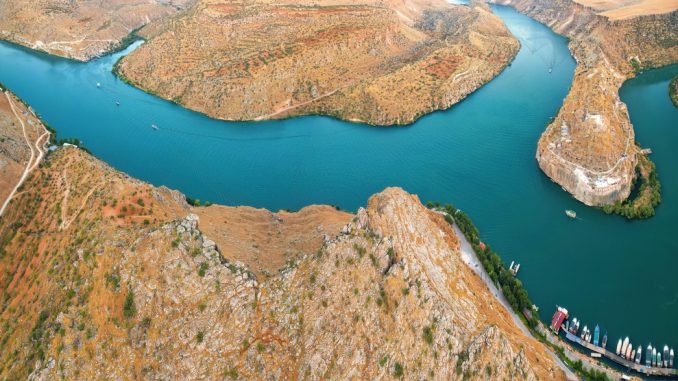
The Euphrates is the longest river in Western Asia – nearly 1,900 miles of waterway that fed the Fertile Crescent and sustained the ancient civilizations of Babylon, Sumer, and Assyria.
Genesis names it explicitly as one of four rivers flowing from Eden. For thousands of years, believers pointed to its existence as evidence that the Genesis account was grounded in real geography.
Secular scientists spent decades trying to explain the river without the Bible.
Now a team led by Andrew Madof – a geologist at Chevron and adjunct senior research fellow at the University of Western Australia – has published a landmark study in Nature Geoscience reconstructing the Euphrates' complete geological history for the first time.
Using seismic imaging of buried seafloor sediments off the coasts of Lebanon and Turkey, satellite data, geological maps, and computer modeling, the team traced the river's origins back approximately 6 million years.
What they found is remarkable.
Two enormous ancient rivers – the Paleo-Karasu and the Paleo-Murat – once flowed separately across what is now Turkey and Syria into a partially dried-out Mediterranean Sea. Both dwarfed anything flowing through the region today: the Paleo-Karasu exceeded the Nile in volume, and the Paleo-Murat outpaced the modern Tigris and Euphrates combined.
Around 5.3 million years ago, a massive drop in Mediterranean sea level forced these rivers to cut deeper into the landscape, triggering a chain reaction of tectonic shifts and catastrophic floods.
Over the following millions of years, those forces redirected both rivers southeast toward the Persian Gulf, where they eventually merged – forming the modern Euphrates between roughly 3.6 and 1.6 million years ago.
The river the Bible named didn't emerge from nowhere. It emerged from a geological upheaval so catastrophic it reshaped an entire region.
What Genesis Got Right That Took Scientists 50 Years to Confirm
For decades, secular scholars pushed two theories about the Euphrates' origins – it either ended in Anatolian lakes, or it flowed southeast into Arabia. Both were wrong.
The truth was more dramatic than either hypothesis: two massive waterways, born millions of years apart, redirected by tectonic forces during one of the most violent geological events in Mediterranean history, eventually colliding to form the river Genesis named.
Biblical archaeologist Juris Zarins spent years arguing that Eden's rivers converged near the head of the Persian Gulf – that the garden itself lies submerged beneath waters that rose at the end of the last Ice Age.
His theory relied on the Euphrates and Tigris as anchors, with the lost Pishon River corresponding to a now-dry riverbed visible in NASA satellite imagery running through western Saudi Arabia toward the Gulf. Zarins' critics dismissed the framework as too convenient.
The Nature Geoscience study doesn't prove Eden's location. But it confirms something equally important – the geographical framework Genesis describes is rooted in real geological history. Two rivers becoming one. A catastrophic transformation of the region. The Euphrates at the center of it all.
Genesis 2 did not say "there was a river somewhere in a general area." It named specific rivers, described specific geography, and placed the Euphrates at the heart of a region that real ancient civilizations built their entire existence around. That is a historical record.
The Euphrates River Bible Prophecy Skeptics Cannot Explain Away
Academics keep stumbling into the Bible's geography and then refusing to say what they've found.
NASA satellite imagery confirmed what archaeologist James Sauer called the Pishon River – a dry ancient riverbed visible only from space, running exactly where Genesis said it should. Göbekli Tepe in southeastern Turkey – the world's oldest known sacred complex, dating to roughly 9600 BC – sits in a region many scholars now associate with the Eden narrative, a once-fertile landscape that desertification later swallowed.
The Euphrates is now at the center of another biblical storyline secular scientists are quietly confirming. The river Genesis named, the same river Revelation places at the center of end-times prophecy, is running dry.
Scientists warn it could be reduced to a trickle by 2040. Revelation 16:12 describes the Euphrates drying up as a sign of the last days. Satellite data shows 34 cubic miles of freshwater have already vanished from the region since 2003.
The Euphrates was real. Its origins were real. The civilization it built was real. And the people who wrote Genesis knew things about this river's role in human history that scientists are only now confirming with seismic imaging and satellite data.
That's not coincidence. That's a document that has been telling the truth for thousands of years.
Sources:
- Andrew S. Madof et al., "Late Miocene Euphrates River Drained into a Partially Desiccated Eastern Mediterranean," Nature Geoscience, June 1, 2026.
- Noah Kirsch, "Scientists May Have Just Solved the Euphrates River's Mysterious Origins," National Geographic, June 1, 2026.
- "Plate Tectonics Shaped the Cradle of Civilization by Merging Two Ancient Rivers," Phys.org, June 2, 2026.
- "How Two Ancient Rivers Gave Birth to the Euphrates," University of Western Australia, June 3, 2026.