
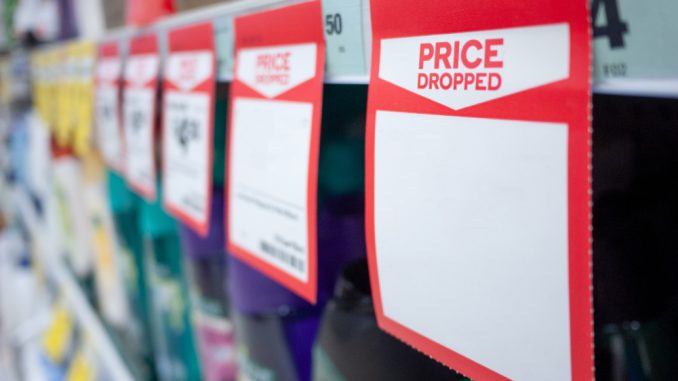
Walmart's rollback prices were a scam – employees swapped in fake inflated original prices to manufacture discounts that were never real.
Now the retail giant is wiring all 5,200 of its US stores with digital price tags that change prices in seconds.
The CEO just promised those prices stay fair – and Walmart has held a patent describing exactly how to change them since 2023.
How Walmart Digital Price Tags Enable Surveillance Pricing
Walmart is replacing paper shelf tags with digital screens across all 5,200 US stores – 2,300 are already live, and the full rollout closes out before the end of 2026.
Walmart's pitch is straightforward – faster updates, less labor, cleaner stores – but that's not all these tags are built to do.
Once connected to your data, the system can read your shopping history, pinpoint your location, and calculate how much you're willing to pay before you ever pick up the item.
The Federal Trade Commission launched a formal investigation into that practice in January 2025, finding that companies are already using customer demographics, browsing history, and location data to charge different shoppers different prices for the same product.
It has a name: surveillance pricing.
Why Walmart's Digital Price Tag Pledge Means Nothing
Walmart CEO John Furner posted a public statement promising the company does not use what customers earn, what they've bought before, or how much they're willing to spend to set a price – and never will.
That statement describes what Walmart is doing today, not what its pricing system is built to do.
In August, the FTC admitted it has no power to prohibit personalized pricing outright, which means there is no law preventing Walmart from turning it on the moment it becomes profitable enough to justify.
Walmart's own patent filings describe exactly what that would look like.
In 2023, Walmart was granted a patent for electronic shelf labels in which prices "may be changed in a dynamic fashion" based on what's in a shopper's cart – with the filing giving a specific example: if a customer has tuna fish, the system may offer them a different price for mayonnaise.
That patent doesn't expire until April 2039.
Walmart has filed two more pricing patents since – one in January 2026 for automatically adjusting prices based on how individual shoppers respond to them, and a second in March 2026 for using a customer's past purchases to recommend prices.
Walmart's response to questions about the filings: "A patent isn't a plan."
Sixty-eight percent of American consumers say dynamic pricing is price gouging, according to a March 2024 CivicScience survey.
The McDonald's AI Pricing Lawsuit Shows Where Walmart Is Headed
McDonald's was hit with a federal class-action lawsuit filed October 2 in Chicago alleging the company used machine-learning software to coordinate menu prices across nearly 14,000 US restaurants in violation of antitrust law.
The lawsuit alleged McDonald's used algorithms to share nonpublic sales data across competing franchises – engineering coordinated price increases without any of the paper trail traditional price-fixing requires.
McDonald's paid $300 million for pricing technology company Dynamic Yield back in 2019 and has been running its centralized pricing tool ever since.
The software allegedly suggests raising an item's price once 30% of franchises have already raised it – a quiet signal that lifts prices across the chain without a single executive phone call.
McDonald's said the lawsuit was "filled with inaccuracies" and vowed to fight it. "AI does not set menu prices at McDonald's restaurants – McDonald's franchisees do," the company said.
Walmart says it isn't using personal data to set prices either.
Kroger has been running electronic shelf label pilots for years, Instacart's pricing tools were caught raising grocery prices in 2025, and lawmakers in more than ten states have introduced legislation to ban the technology outright – including New Jersey, which signed a surveillance pricing protection bill into law in July 2026.
Walmart Surveillance Pricing Is One Switch Away
Corporate America spent four years raising your grocery bill and calling it inflation.
Now those same companies are building the infrastructure to make that pricing structure permanent – automated, personalized, and invisible.
The Walmart app already knows your zip code, your purchase history, and how often you buy every item in your cart.
The electronic shelf labels are the final piece – the hardware that turns what Walmart knows about you into the number on the tag before you reach the shelf.
Furner's statement covers October 2026 – it says nothing about January 2027, when the last paper price tag comes down and all 5,200 stores are fully wired.
When a CEO has to issue a statement reassuring customers that a technology he just installed in every store won't be used against them, that's not a promise.
That's a preview.
Sources:
- AP, "Walmart says it's not using personal information to set prices as it expands digital shelf labels," Fox5 Vegas, September 28, 2026.
- Sara McGiff, "Walmart wants digital price tags in all its stores but consumers fear it's the end of one-price-for-all shopping," Daily Mail, September 29, 2026.
- AP, "McDonald's sued over AI tool that recommends prices to US franchisees," Multiple Fox Affiliates, October 8, 2026.
- Federal Trade Commission, Surveillance Pricing Market Study, FTC.gov, January 2025.
- Retail Dive, "Walmart CEO Addresses Dynamic Pricing Concerns," Retail Dive, September 2026.
- CivicScience, "Consumers view dynamic pricing as price gouging," March 2024.