
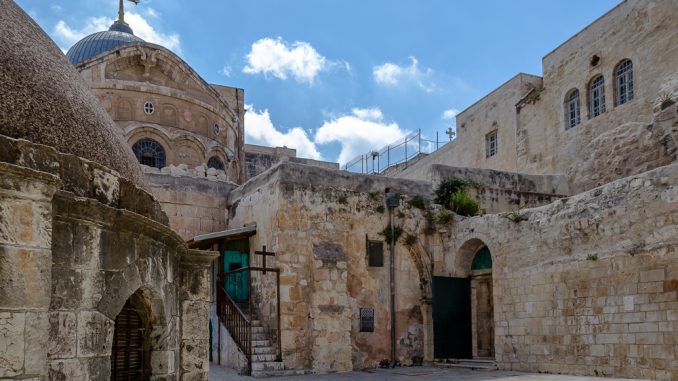
Secular scholars have spent decades telling believers the Bible's description of Jesus' burial site was too convenient to be real.
Now Italian archaeologists have dug beneath the Church of the Holy Sepulchre – and the ground itself just weighed in.
What they found beneath that ancient floor matches the Gospel of John with a precision that left the research team documenting a funerary landscape no one expected to still be there.
Ancient Olive Trees and the Tomb of Jesus Found Beneath Church of the Holy Sepulchre
The Gospel of John is precise: "Now in the place where he was crucified there was a garden; and in the garden a new sepulchre, wherein was never man yet laid."
For skeptics, that detail was always an easy target – a convenient literary flourish with no physical evidence to back it up.
Not anymore.
Researchers from Sapienza University of Rome spent three years excavating beneath the floor of Jerusalem's Church of the Holy Sepulchre, beginning with a routine restoration project in 2022.
What they uncovered wasn't routine.
Beneath the stone floor lay the remnants of ancient olive trees, grapevines, cultivated garden plots, and multiple rock-cut tombs – exactly the combination the New Testament describes.
Lead archaeologist Francesca Romana Stasolla confirmed the discovery to the Daily Mail: "We have found evidence of a funerary landscape, alongside small areas planted with vines and olive trees, as well as a pastoral landscape characterized by sporadic human activity."
The findings fill a 98-page report published in Liber Annuus, the peer-reviewed archaeological journal of Jerusalem's Studium Biblicum Franciscanum.
The site was once a massive stone quarry cut into the hillside just outside Jerusalem's ancient walls – exactly where Hebrews 13:12 says Jesus "suffered outside the city gate," close to the city but beyond its boundary.
As quarrying ended, the lower sections were packed with soil, broken up by rough stone dividers into cultivated plots.
Rock-cut tombs were carved directly into the quarry's exposed stone faces.
Matthew, Mark, and Luke each describe Jesus' grave as carved from rock.
Every geographic and physical detail in the New Testament account checks out against what the excavation found.
How the Jesus Burial Site Survived 200 Years of Roman Suppression
This wasn't just a garden discovery.
It was the final piece of a 2,000-year trail that Rome itself tried to erase.
Early Christian writer Eusebius recorded in the fourth century that the location of Jesus' tomb had been continuously remembered by the Jerusalem Christian community – even while a pagan temple sat on top of it.
Emperor Hadrian built that temple in 135 AD in a deliberate attempt to wipe the site from Christian memory.
It didn't work.
Constantine's mother, Helena, arrived in Jerusalem around 325 AD acting on exactly that preserved oral tradition.
Workers demolished the pagan temple and dug through the rubble.
The tomb was still there.
Constantine then made a decision archaeologists now find extraordinary: he allowed different sections of the enormous church complex to fall out of architectural alignment rather than move the tomb even slightly.
A builder only does that when he knows exactly what he's protecting.
The new excavations also found a Roman structure from Hadrian's reign built directly against the tomb – blocking access to it for two centuries before Constantine's workers tore it down.
Oxford archaeologist Martin Biddle theorized that Christian pilgrims scratched a graffito into the rock before Hadrian's temple was built – essentially a "This is the Tomb of Christ" marker – preserving the location underground for generations.
Mortar sampled from between the original limestone burial surface and the marble slab covering it has been dated to approximately AD 345 – Constantine's era – confirming the timeline Eusebius described.
The secular press is reporting all of this with careful hedging – consistent with, parallels the account, doesn't definitively prove.
Apply that standard to any other site in ancient history and half of what archaeology accepts as settled collapses with it.
The evidence shows a 2,000-year-old chain of Christian memory pointing to one specific spot – confirmed to contain a first-century garden, rock-cut tombs, cultivated olive trees, and a location outside ancient Jerusalem's walls but close to the city.
The early Christians venerated this site.
Constantine refused to move it one inch.
Believers have prayed there for 1,700 years.
For millions of Christians, that's not a footnote, that's confirmation.
Sources:
- Stacy Liberatore, "Discovered: Stunning 2,000-year-old secret beneath Jesus 'burial site' that perfectly aligns with Bible account," Daily Mail, August 25, 2026.
- Ben Cost, "'True tomb' of Jesus Christ found after 2,000 years — and it matches the Biblical telling," New York Post, August 27, 2026.
- Andrea Margolis, "Excavation near site where Jesus was crucified and buried results in ancient discovery," Fox News, April 4, 2025.
- "Photos: Archaeologists uncover early use of site beneath Holy Sepulcher in Jerusalem," Catholic World Report, April 18, 2025.