
Construction workers in northern Italy broke ground on a routine housing project.
What they uncovered had been buried for 1,600 years.
And what workers found beneath that fish market has Christians across the world talking.
The Ancient Christian Church Buried Beneath an Italian Fish Market for 1600 Years
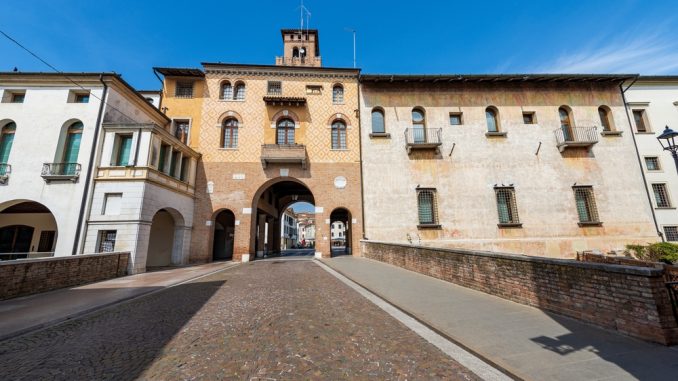
Oderzo is a quiet town in northeastern Italy, tucked between the Piave and Livenza rivers about 40 miles from Venice.
The Romans knew it as Opitergium – one of the great cities of the ancient Veneto region, with a population of 50,000 at its peak in the second century A.D.
Excavations began there last November, ordered by Italian archaeological authorities before a residential development project could break ground in the city's historic center.
Previous digs in the area had turned up Byzantine fortifications, ancient mosaics, and burial remains.
The team expected more fragments.
What they found instead stopped the entire project.
Archaeologists Uncovered a 1600 Year Old Early Christian Basilica Near Venice
The first clue was a handful of black-and-white mosaic tiles.
As excavators widened their dig, the tiles multiplied – until the team realized they were standing above something massive.
"We began to think we were looking at a building – a church," said archaeologist Simone Colucciello, who directed the excavation. "We still had no idea how large it actually was."
The structure turned out to be a monumental three-aisled basilica measuring 75 feet wide and at least 98 feet long.
Its foundations – built from brick and mortar nearly four feet thick – rested on wooden piles driven deep into the alluvial soil, the same engineering technique Romans used across the empire to build on soft ground near water.
The church dates to the late fourth or early fifth century A.D., placing it squarely in the era when Christianity was transforming from a persecuted faith into the dominant religion of the Roman world.
Emperor Constantine had legalized Christianity in 313 A.D. with the Edict of Milan – signed, fittingly, in northern Italy.
Within a generation, churches like this one began rising across the empire.
The Archaeological Superintendency of Venice called the discovery "exceptionally significant," saying it opens "a new chapter in the history of ancient Opitergium during the Late Roman and Early Medieval periods."
1600 Year Old Mosaic Floors Survived Intact Beneath the Former Market
The mosaics alone are a revelation.
Thirty square meters of decorative pavement held their color for sixteen centuries while the world above them changed beyond recognition.
Researchers note the mosaic style matches closely those found at other early Christian sites in the Veneto region, including Concordia Sagittaria and Aquileia, where a separate early Christian basilica was confirmed just this past February.
Alongside the church walls, archaeologists found four burial sites containing the remains of seven individuals.
Anthropologists are currently studying the remains, with additional specialized analyses planned.
The eastern end of the church has not yet been excavated – and researchers say the full complex could run considerably larger than what is currently visible.
Oderzo's mayor, Maria Scardellato, called the find "truly an incredible surprise."
"We never expected to find what we actually discovered," added Maria Cristina Vallicelli of Italy's Superintendency for Archaeology.
The ancient city of Opitergium endured invasions by the Visigoths, the Huns, and the Ostrogoths before the Lombards leveled it in 667 A.D.
The church went with it – its stone hauled away, its footprint buried, its existence erased from the record for thirteen centuries.
A city of commerce unknowingly preserved a city of faith
Opitergium's very name traces to a Venetic word for "market square."
It was a trading city, a crossroads city, a city built on commerce – and for sixteen centuries, its merchants, fishmongers, and residents went about their business directly above the foundations of one of the earliest Christian churches ever built in the region.
New architectural plans are being drawn up to integrate the basilica's mosaics and foundations into the residential development – allowing visitors to see the ancient church while the city continues to grow around it.
The mosaic tiles that first caught an excavator's eye last November may one day be visible to anyone who walks through a new Oderzo neighborhood.
What the builders meant to cover has instead been given back to the light.
Sources:
- Andrea Margolis, "Significant Early Christian Church Emerges Beneath Former Fish Market in Ancient City," Fox News, July 15, 2026.
- Staff, "Ancient Basilica Found Beneath Former Fish Market," Heritage Daily, July 2026.
- Staff, "1,600-Year-Old Early Christian Basilica Discovered in Northern Italy," Basilica.ro, July 2026.