
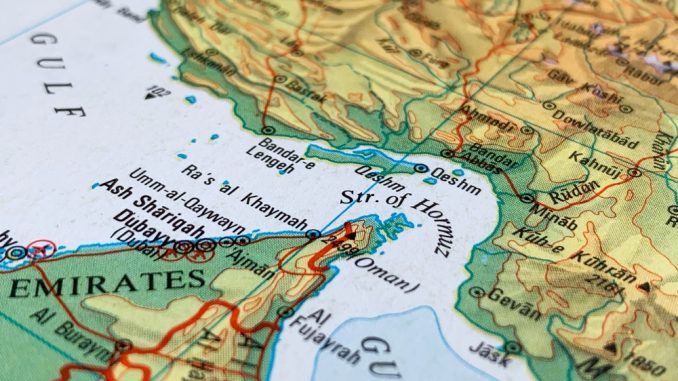
Iran has been charging ships $2 million a crossing to transit the Strait of Hormuz.
Trump just told the Navy to go in and take it back.
What they found when they got there is something Obama left behind – and it changes the danger calculation entirely.
Operation Epic Fury Begins With a Fleet Obama Left Broken
Iran has packed the Strait of Hormuz with naval mines since the war began – and the Navy Trump just sent in to clear them is not the Navy America had forty years ago.
Obama's Pentagon decommissioned the Avenger-class minesweepers – purpose-built wooden ships designed to pass over live mines without setting them off, a capability no metal vessel can replicate.
Their replacement, the Littoral Combat Ship, is a metal vessel that has never been used in combat mine-clearing.
A 2022 Government Accountability Office report found the LCS fleet has "several significant challenges," including failure rates of mission-essential equipment.
Before the war started, one pre-deployment exercise off San Diego ended with a runaway underwater drone drifting toward the Mexican border that the mothership could not recover.
The Washington Institute estimated years ago that clearing the Strait of Hormuz could require up to 16 mine countermeasure vessels. The Navy has seven.
Trump posted on Truth Social that Iran's tolls were "WORLD EXTORTION" and called on allies to send minesweepers. The UK issued a pledge to "contribute to appropriate efforts," France and Germany signed a joint statement, and every one of them left the heavy lifting to the U.S. Navy.
So Trump sent what he had. On Saturday, the USS Frank E. Petersen and USS Michael Murphy – two Arleigh Burke-class guided-missile destroyers – crossed the Strait of Hormuz for the first time since the war began February 28. They are now in the Arabian Gulf, setting conditions for the clearance operation.
CENTCOM commander Adm. Brad Cooper announced: "Today, we began the process of establishing a new passage."
Inside the US Navy Mine Clearance Operation Iran Cannot Stop
The Navy is deploying the Knifefish – a 1,700-pound unmanned underwater vehicle built by General Dynamics that hunts mines on the seabed using sonar – including ones buried in silt or sitting among debris that would fool a less sophisticated system.
Torpedo-shaped, it runs well ahead of any manned vessel and maps the seabed before a sailor gets near.
MH-60S helicopters equipped with the Airborne Laser Mine Detection System work the surface layer, scanning for floating mines from altitude. When one is found, the Airborne Mine Neutralization System drops a small robotic device onto the explosive and detonates it remotely.
Iran planted two known types. The Maham 3 is a moored mine with sensors. The Maham 7 rests on the seabed until a target passes within range.
American intelligence assessed at least a dozen in the waterway – and last Friday, it emerged that Iran has lost track of some of the mines it laid, meaning live explosives are now drifting through shipping lanes with no one certain where they are.
Trump told Fox News exactly what he sent in.
"We have highly sophisticated underwater minesweepers, which are the latest and the greatest, but we're also bringing in more traditional minesweepers," he said on Sunday Morning Futures. "I understand the UK and a couple of other countries are sending minesweepers. A lot of countries don't have minesweepers."
The Last Time Iran Mined the Strait of Hormuz America Won
Iran tried this exact tactic forty years ago.
During the Tanker War of the late 1980s, Iran mined the Persian Gulf and targeted commercial shipping to gain leverage during the Iran-Iraq war.
America launched Operation Earnest Will to escort oil tankers through the Persian Gulf and Iran backed down.
The guided-missile cruiser USS Princeton struck two mines during Operation Desert Storm in 1991, injuring three sailors and knocking the ship out of the war. After that war ended, U.S. minesweepers spent months hunting down more than 1,000 mines Iraq had laid off Kuwait. The work is slow, dangerous, and unglamorous. It cannot be rushed.
The stakes this time are higher than anything the 1980s produced. Iran has mined a waterway carrying 20 percent of the world's oil supply. More than 2,000 ships sit stranded waiting to move. Oil crossed $100 per barrel the day peace talks collapsed and has not come back down.
The IRGC vowed a "strong response" to any military vessels in the strait.
Mohammad Bagher Ghalibaf – Iran's parliament speaker and chief negotiator in Islamabad – flew home and told reporters his country would not bow to threats. Tehran even denied the American destroyers had entered the strait at all – claiming no vessel crosses without Iran's permission.
Trump posted his answer on Truth Social: "Any Iranian who fires at us, or at peaceful vessels, will be BLOWN TO HELL!"
The destroyers are in position. The drones are being staged. Iran's mines are still in the water – including the ones Tehran can no longer find. Trump is sending the most powerful navy on earth into a minefield that even the people who built it can no longer fully map.
Sources:
- New York Post, "How the US will clear Iran's mines in the Strait of Hormuz," April 12, 2026.
- Task & Purpose, "Two destroyers cross Strait of Hormuz ahead of mine clearance mission," April 11, 2026.
- Hunterbrook Media, "Demining Hormuz: How the U.S. Navy Arrived at Worst-Case Scenario Unprepared," March 13, 2026.
- Navy Times, "The US Navy decommissioned Middle East minesweepers last year," March 12, 2026.
- USNI News, "Two U.S. Warships Sail Through Strait of Hormuz to Establish New Passage," April 11, 2026.
- Axios, "Trump announces naval blockade on Iran after peace talks collapse," April 12, 2026.