
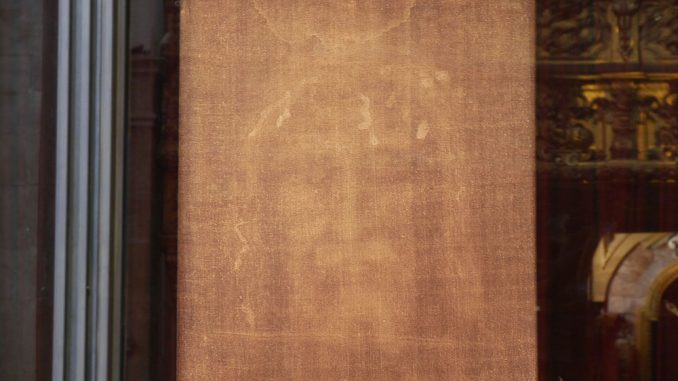
Oxford University ran carbon dating on the Shroud of Turin in 1988 and told the world the case was closed.
Now the scientists who said that are the ones with a problem.
What researchers just confirmed about the blood on that cloth makes forgery forensically impossible.
The Carbon Dating That Was Never as Settled as They Claimed
X-ray examination of the Shroud shows that wherever there is blood on the linen, there is no image underneath it.
The blood came first.
The X-ray data is unambiguous: the image-formation process was blocked wherever blood had already soaked the cloth — which means the linen was in contact with a bleeding body before the image appeared.
Any forger working in paint or dye would have laid down the body image first and applied blood last.
The Shroud is the opposite of that — and no technique of forgery produces that result.
Australian researcher William West, whose new book The Shroud Rises compiles every major scientific finding on the cloth, put it plainly: two or three of these pieces of evidence are impressive, but together they are overwhelming.
That is where the science stands now.
What the Shroud of Turin Research Project Found – and Nobody Covered
In October 1978, a 32-member team of American scientists, engineers, and medical professionals spent 120 hours conducting the most comprehensive examination of the Shroud ever performed.
The team was called STURP – the Shroud of Turin Research Project.
Their findings were published across more than 20 scientific journals.
Conclusion: the image is not paint, not dye, not photography, and no known process explains how it formed.
Ten years later, Oxford University ran carbon dating on a small sample of linen and announced the Shroud was medieval – woven between 1260 and 1390 AD, over a thousand years after the death of Christ.
Professor Edward Hall held a press conference and called anyone who questioned the results the equivalent of a flat earther.
The media accepted it as settled science and moved on.
Except carbon dating is wrong far more often than anyone admits.
West documented the track record: a freshly killed seal dated as 1,300 years old, living snails tested at 26,000 years old, a Viking horn dated to the year 2006.
In April 2022, Italian scientists from the National Research Council ran wide-angle X-ray scattering – a completely different test specifically designed for ancient linen.
The results were fully compatible with a cloth from the first century AD – consistent with the time of Christ.
University of Padua Professor Giulio Fanti ran independent tests and reached the same conclusion.
The flat earthers turned out to be right.
The Blood Evidence No Forger in Any Century Could Have Faked
There is no paint on the Shroud, no dye, no silver or nitrate – the chemicals used in early photography.
The image is formed by microscopic yellowed fibers on the absolute surface of the linen, so shallow it could be scraped off with a razor blade.
Italian physicist Paolo Di Lazzaro led a team that spent years firing the most powerful ultraviolet lasers available at untreated linen trying to reproduce it.
They could not.
British television director David Rolfe posted a million-dollar prize for anyone who can replicate the image using methods available in the Middle Ages.
Nobody has collected.
The image also contains encoded three-dimensional spatial data – something human technology could not detect until aerospace scientists applied image analysis tools developed for space photography in 1976.
A medieval forger would have needed to embed 3D mapping into linen fibers two centuries before photography existed, using a method that would not be discovered until the computer age.
The forensic details are just as damaging to the forgery theory.
The nail wounds are through the wrists, not the palms.
Every painting of the crucifixion for centuries showed nails through the palms.
But a nail through the palm cannot support the weight of a human body – modern biomechanics confirmed that.
A forger copying every painting he had ever seen would almost certainly have put them in the wrong place.
The Shroud puts them in the right place.
Microscopic dirt on the cloth matches the chemical fingerprint of Jerusalem soil.
Pollen samples found in the linen bloom only in spring in Jerusalem – the exact season the Gospels record the crucifixion.
Dr. Jeremiah Johnston, one of the leading Shroud experts, told CBN News that 102 scientific disciplines have now spent over 600,000 hours studying the cloth.
The great majority concluded it is 2,000 years old.
Professor Hall Was Wrong. So Was Everyone Who Believed Him.
The 1988 carbon dating result was announced with a press conference and a sneering dismissal of believers.
The 2022 results that overturned it were published quietly in a scientific journal and picked up by almost nobody in the media.
That is not how science works.
That is how narrative protection works.
Every few years, someone publishes a new attack on the Shroud.
It lands everywhere.
The rebuttal gets buried.
Last year a Brazilian 3D artist published a paper claiming the image was made from a low-relief sculpture.
Every major outlet ran it.
The guardians of the Shroud in Turin publicly demolished the methodology – software not designed for scientific purposes, simulated physics that bear no relationship to physical reality.
That rebuttal landed nowhere.
Professor Hall stood at his press conference in 1988 and told the world that believers were fools.
The X-ray tests, the 2022 dating, the 600,000 hours of multi-disciplinary research, the blood-before-image forensic record – all of it says Hall was wrong.
Your faith never needed this cloth to be real.
But the people who mocked you for believing it might be – they were not following the science.
The science was following you.
Sources:
- Christopher Stevens, "Final proof Jesus WAS buried in the Shroud of Turin?" Daily Mail, March 1, 2025.
- James Lasher, "New Evidence for Shroud of Turin: Expert Says It's 'Beyond All Doubt,'" Charisma Magazine, April 28, 2025.
- James Lasher, "Shroud of Turin Breakthrough: Scientists Admit Technology Cannot Recreate Image," Charisma Magazine, April 8, 2026.
- Daniel Payne, "Shroud of Turin Center Disputes New Study," Catholic News Agency, August 5, 2025.
- Tom's Theology Blog, "The Shroud of Turin Research Project (STURP)," April 12, 2025.