
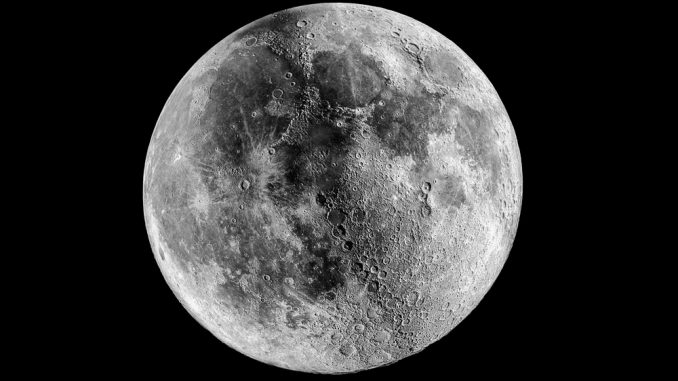
Genesis 1 said God created the moon in a single day.
Scientists built the most sophisticated moon-formation model ever constructed to settle the question once and for all.
The answer they got wasn't the one they expected.
The Moon Formation Simulation That Changed the Science
Researchers at the Southwest Research Institute and the University of Arizona built a new moon-formation model with a variable their predecessors had left out entirely: the actual geologic strength of the colliding planets, adjusted for temperature.
The old models treated Earth and a Mars-sized planet called Theia – which scientists believe slammed into the young Earth 4.5 billion years ago – like two enormous water balloons. Fluid, structureless, predictable. The new model treated them like actual rocky planets, because that's what they were.
The difference changed everything.
In one of lead scientist Dr. Adeene Denton's simulations, a fully intact moon appeared in orbit around Earth within approximately five hours of the collision. Not thousands of years. Not millions. Five hours.
"When I used the same parameters as original impact modeling – down to the equal temperature structures inside both bodies – within around five hours, an intact moon emerged," Denton said.
What Genesis 1 Says God Did in a Single Day
Genesis 1:14-19 describes the fourth day of creation: God places two great lights in the heavens – the sun to rule the day and a lesser light to rule the night. The text presents this as an event, not a process. Immediate, complete, finished.
For centuries, skeptics pointed to secular science as proof the Bible was wrong. The moon couldn't have appeared quickly – gravity doesn't work that fast, the debris would take eons to coalesce, the physics were settled.
Now the physics say otherwise. Believers online didn't miss it.
"The Book of Genesis told me this a while ago," one X user wrote after the study made headlines.
"God can do whatever He wants, whenever He wants," posted another.
Scientists ran the numbers and got what Scripture described. The moon – fully formed – appearing in hours.
Why Scientists Who Ignored This Factor Were Wrong
What makes Denton's finding genuinely striking isn't just the speed. It's what the researchers had to add to their model to get that result: reality.
For decades, researchers building giant impact simulations left rock strength out of the math entirely – the assumption being that in a collision this violent, the rigidity of the material wouldn't change the outcome.
When Denton's team put it back in, along with how temperature affects that strength, the moon didn't slowly accumulate from a disk of rubble. In at least one scenario, it snapped into orbit nearly whole.
The Institute for Creation Research noted years ago that every time secular scientists update their moon-formation models toward greater realism, they inch closer to what the Bible always described. This latest study fits that pattern exactly. Researchers set out to refine a naturalistic model. They ended up producing a timeline that scripture readers find familiar.
Denton and her colleagues made no theological claim. The study, published September 1 in The Astrophysical Journal Letters, is careful and scientific. But the finding belongs to everyone now – and tens of millions of believers aren't treating it as a coincidence.
When Science and Faith Point to the Same Answer
The culture has spent a generation telling Christians to check their faith at the door when science enters the room. Pick one or the other, the argument goes. Faith is for Sunday. Physics is for the rest of the week.
Stories like this one are why that framing is collapsing.
The output of a peer-reviewed simulation echoed a text written thousands of years before computers existed. That's not formal proof of creation, and Denton's team never claimed otherwise.
But it's also not nothing. Tens of millions of Americans who take Scripture seriously know exactly what it feels like when the universe seems to confirm what they already believed.
The moon hangs in the same sky it always has. It got there in five hours, the computers now say. Genesis didn't specify the mechanism. It just said God made it, and it was good.
That's been enough for a few thousand years. It'll hold up fine now.
Sources:
- Southwest Research Institute, "SwRI-led modeling identifies new scenarios for Moon formation," SwRI.org, September 1, 2026.
- C. Adeene Denton et al., "Collisional Capture of an Intact Moon Depends on Strength," The Astrophysical Journal Letters, September 1, 2026.
- University of Arizona News, "Soft and stretchy or rock solid? New modeling study sheds light on how the Earth got its moon," Arizona.edu, September 1, 2026.
- "Moon Formed in Just Hours?" Institute for Creation Research, ICR.org.