
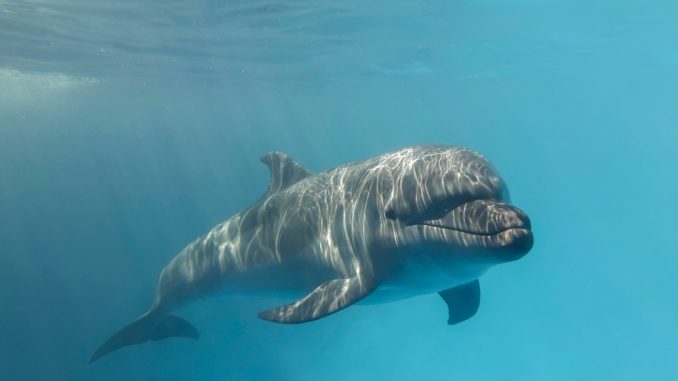
Iran owns a fleet of Soviet-trained killer dolphins — and this week Tehran quietly dusted them off.
Iran bought that program in 2000 – and this week Tehran quietly dusted it off.
Pete Hegseth faced that question at the Pentagon Tuesday and said something nobody in that room expected.
Iran's Kamikaze Dolphins Have a 25-Year History Nobody Talked About
The Soviet Union spent decades turning bottlenose dolphins into weapons.
Actual trained dolphins – conditioned to drive harpoons into enemy divers, locate and mark mines, and execute kamikaze strikes by carrying explosives directly into enemy ships.
When the USSR collapsed, Ukraine inherited the program at a facility near Sevastopol in Crimea.
By 2000, Ukraine was out of money. Chief trainer Boris Zhurid was out of fish and medicine for his animals and had no path to keeping the program alive.
So Iran bought them – the dolphins, Zhurid, and the entire operation – and relocated everything to an Iranian oceanarium in the Persian Gulf.
A Wall Street Journal report last week revealed Iranian officials are now weighing whether to revive that program and deploy mine-carrying dolphins against American vessels in the Strait of Hormuz.
What Pete Hegseth Said at the Pentagon Briefing That Iran Noticed
A reporter asked Pete Hegseth directly at a Pentagon briefing: does Iran have kamikaze dolphins?
Hegseth claimed Iran doesn't have an active program right now.
Then he said something nobody expected.
"I can't confirm or deny whether we have kamikaze dolphins – but I can confirm they don't."
Joint Chiefs Chairman Dan Caine laughed and referenced sharks with laser beams from Austin Powers.
Hegseth didn't laugh with him.
Those three words – "I can't confirm" – are not a throwaway.
Inside the US military, "I cannot confirm or deny" means the capability exists in some classified form, its status is protected, and disclosing it would compromise operations.
Hegseth stood at a Pentagon lectern in front of the world and deliberately declined to tell Iran whether America has trained combat dolphins in the water right now.
The US Navy Marine Mammal Program Has Been in These Waters Before
The United States Navy Marine Mammal Program has been running since 1959.
That's 67 years of continuous dolphin training at Naval Base Point Loma in San Diego.
The program deployed mine-clearing dolphins to the Persian Gulf in 1987 – the last time Iran threatened these exact shipping lanes.
It deployed again in 2003 to clear more than 100 antiship mines and underwater booby traps from the port of Umm Qasr during the Iraq War.
The Navy currently operates roughly 70 trained dolphins divided into five specialized teams – mine detection, swimmer detection, and equipment recovery – all capable of deploying within 72 hours anywhere in the world.
America has had a serious answer to this absurd question since before most of Iran's military leadership was born.
Iran's conventional military has taken devastating losses since Operation Epic Fury launched February 28.
More than 120 Iranian naval vessels have been destroyed or incapacitated.
Major naval facilities at Bandar Abbas – sitting right at the entrance to the Strait of Hormuz – were hit in the opening hours of the conflict.
A regime with a functioning conventional navy doesn't dust off Soviet dolphin files from 25 years ago.
Iran is reaching.
Operation Project Freedom Just Made the Strait of Hormuz a Biology Problem
The Strait of Hormuz is 21 miles wide at its narrowest point.
Iran closed it March 4 using sea mines, ship seizures, and fast-attack boat swarms.
Mine clearance is the mission the US Navy Marine Mammal Program was built for – and the mission it executed in these same waters before.
Dolphins detect mines using biological sonar that no man-made technology has matched after 67 years of trying.
They work in murky water, complex sea floors, and conditions where human divers can't operate safely.
Trump launched Operation Project Freedom on May 4 – a US Navy mission to escort neutral ships through the Gulf.
If Iranian dolphins are going into that water, American naval planners already know it.
Hegseth made sure on Tuesday that the same courtesy doesn't extend to Tehran.
He confirmed what Iran doesn't have.
He refused to say what America does.
Sources:
- Caitlin Doornbos, "Hegseth denies Iran has 'kamikaze dolphins' — but suggests US might," New York Post, May 5, 2026.
- Wall Street Journal, "Iran Weighs Dolphin Deployment in Strait of Hormuz," The Wall Street Journal, April 2026.
- Fox News, "Trump launches Operation Project Freedom to escort ships through Gulf," Fox News, May 4, 2026.
- State Department Office of the Legal Adviser, "Operation Epic Fury and International Law," US Department of State, April 2026.
- Gulf International Forum, "Operation Epic Fury and the Collapse of Iran's Layered Naval Defense," Gulf International Forum, March 2026.