
Washington's army was weeks away from starving at Valley Forge.
One Pennsylvania rifleman climbed a tree with a long rifle and took three shots that ended the battle.
Those three shots gave America its first national Thanksgiving.
How Daniel Morgan's Riflemen Turned the Battle of Saratoga
By September 1777, the British had captured Philadelphia and chased the Continental Congress out of the capital.
George Washington's main army had lost three straight battles – Brandywine, Paoli, and Germantown – and morale was collapsing.
Washington sent Colonel Daniel Morgan's Provisional Rifle Corps north – roughly 500 sharpshooters handpicked from Pennsylvania, Maryland, and Virginia – to block a British invasion from Canada.
General Horatio Gates would later call them "the Corps the British feared the most," and they had earned every word of it.
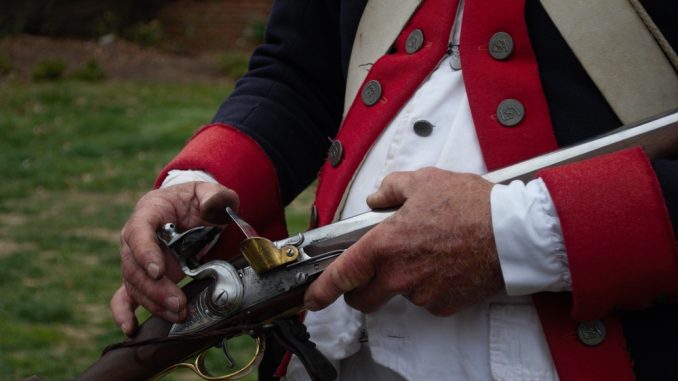
Morgan's men carried Pennsylvania long rifles – weapons that could reach targets at 300 yards while standard British muskets topped out at 100.
Unlike regular soldiers, they moved through no-man's-land before and after every battle, eliminating British scouts and blinding Crown forces.
Their mission was simple: find the British officers and kill them.
At the Battle of Freeman's Farm on September 19, Morgan's riflemen picked off British commanders until Burgoyne's army had no one left to give orders.
The British advance stalled.
Timothy Murphy's 300-Yard Shot and the First National Thanksgiving
On October 7, 1777, at the Battle of Bemis Heights, Burgoyne launched his final desperate push.
His army was rallying around Brigadier General Simon Fraser – a British commander who had held that line together through every American assault.
Benedict Arnold rode to Colonel Morgan and pointed straight at Fraser.
"That man is worth a regiment," Arnold said, ordering Morgan to have him shot.
Morgan turned to his best marksman – Sergeant Timothy Murphy, an Irish backwoodsman from Pennsylvania's frontier.
Murphy climbed a tree.
At roughly 300 yards – a nearly impossible shot for the era – Murphy leveled his Pennsylvania long rifle at a man on horseback.
His first shot missed.
His second grazed Fraser's horse.
His third hit Fraser through the stomach, and the general was dead by nightfall – his line collapsing around him.
Ten days later, on October 17, 1777, General Burgoyne surrendered his entire army – nearly 7,000 soldiers – to American forces.
It was the first time in the entire war that a British field army had been captured.
John L. Plaster – a former U.S. Special Forces operator who trains modern snipers – visited the Saratoga battlefield with a laser rangefinder and measured the shot himself.
"Some historians hint that this is the most decisive shot in all military history," Plaster said.
News of the victory reached the Continental Congress, meeting in exile at York, Pennsylvania.
Samuel Adams – the Father of the Revolution – led the committee that drafted the proclamation.
On November 1, 1777, Congress adopted it: December 18 would be a national day of "solemn Thanksgiving and praise" for all 13 states.
Washington delayed the Continental Army's march into Valley Forge by one day so his men could observe it.
Soldier Joseph Plumb Martin recorded what the starving troops actually received for that "sumptuous" Thanksgiving meal: half a gill of rice and a tablespoon of vinegar.
They were grateful anyway.
Adams wanted "one heart and one voice" to express "the grateful feelings" of the American people to Almighty God.
The first Thanksgiving had nothing to do with harvest tables or family recipes – it was a military victory celebration declared by men who thanked God they were still alive.
This week, Loudoun County Public Schools in Virginia recommended a Thanksgiving lesson for children as young as second grade with a slide titled "Day of Mourning."
Second graders.
The same district that has no room for Timothy Murphy made room for a HuffPost video on why some Native Americans refuse to celebrate Thanksgiving at all.
Murphy and his fellow riflemen weren't part of a standing army – they were private citizens, gun-owning frontiersmen whose marksmanship saved the republic.
The National Rifle Association has pointed to Timothy Murphy as the prime example of the citizen rifleman – the precise argument the Second Amendment was written to protect.
Somewhere between the Pilgrims and the grocery store turkey, the country forgot that Thanksgiving started with a 300-yard shot nobody saw coming from a man nobody remembers.
His name was Timothy Murphy, and America has been thanking him every November since 1777 without knowing it.
Sources:
- National Park Service, "Daniel Morgan," Saratoga National Historical Park, NPS.gov.
- American Battlefield Trust, "10 Facts: The Battle of Saratoga," Battlefields.org.
- John L. Plaster, quoted in "Timothy Murphy: Is the Revolutionary War Sniper's Shot the Best Ever?" Athlon Outdoors.
- National Park Service (nationalparkstraveler.org), "Timothy Murphy and the Citizen Rifleman," NPS.gov.
- Patrick K. O'Donnell, "America's First Thanksgiving Was Made Possible by Daring Revolutionary Snipers," Fox News, November 25, 2026.
- Washington Free Beacon, "Thanksgiving Is a 'Day of Mourning,' Lesson Plan Recommended to Loudoun County Second Graders Says," Washington Free Beacon, November 2026.