
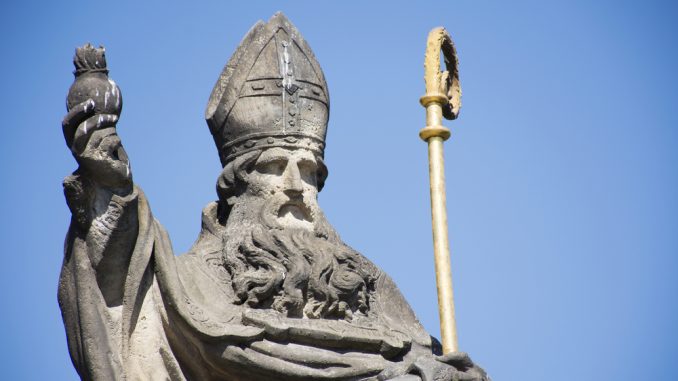
St. Augustine shaped Western Christianity more than any figure outside Scripture itself.
Scholars just authenticated two of his sermons that nobody has seen in 1,600 years.
What he wrote inside them is something theologians say has never appeared anywhere in the Christian record.
How a Medieval Manuscript Hidden in a Polish Monastery Yielded Two Lost St Augustine Sermons
Professor Christian Tornau was minding his own business at the University of Würzburg when a call came in from the Bad Doberan Monastery Association in Germany.
They had a manuscript they needed someone to read.
Tornau agreed, examined the 12th-century document, and found six sermons attributed to St. Augustine of Hippo – the North African bishop whose writings on grace, free will, and the nature of God shaped the Western church for sixteen centuries.
Four of the sermons were already known.
Two were not.
"Two of the six sermons are previously undiscovered writings by Augustine," Tornau confirmed.
The manuscript had been copied at Bad Doberan Abbey during the 12th century, then kept at a monastery in Pelplin, Poland – most likely transcribed from an even earlier source at Amelungsborn Abbey in Lower Saxony, whose original library was burned to ash during the Thirty Years' War.
The trail is cold. The discovery is real.
Why 20 Scholars Flew to Vienna to Read Two Sermons
Tornau was not taking chances.
Forged Augustine writings are not uncommon across 1,600 years of manuscript history, so he assembled roughly 20 Latin specialists, convened a summer school in Vienna, and subjected both sermons to exhaustive scrutiny – rhetoric, humor, prayer style, North African liturgical markers that could not have existed in medieval Europe.
"Our final verdict is that they are indeed authentic," Tornau told Fox News Digital.
A scholarly edition is expected by the end of 2026.
What the Witch of Endor and King Saul Have to Do With These Lost Augustine Sermons
Both sermons address the Witch of Endor – one of Scripture's most troubling passages.
In 1 Samuel 28, King Saul – abandoned by God, facing certain death in battle against the Philistines – secretly consults a medium. He asks her to summon the spirit of the dead prophet Samuel. The apparition appears, condemns Saul for his disobedience, and foretells his death the following day.
Saul dies in battle. The story ends there.
For 1,600 years, the dominant Christian interpretation has been harsh: Saul was a cautionary tale, a man who chose disobedience and paid the ultimate price.
Augustine read that story and saw something every other Church Father missed.
The first sermon, preached on a Sunday, walks Augustine's congregation through the theodicy question – if God is all-powerful, why would He permit what looks like a diabolical act? Augustine lays out the interpretations without settling them, sending his congregation home to sit with an open question until Wednesday.
The second sermon weighs the alternatives – and raises something no surviving ancient Christian source had ever raised before.
Augustine entertains the genuine possibility that King Saul repented after hearing Samuel's prophecy, and was ultimately redeemed.
"This is unparalleled in Augustine and in ancient Christianity in general, where we find a very negative image of Saul," Tornau told Fox News Digital.
Augustine did not declare it settled doctrine. But he refused to dismiss it – argued for it, weighed it seriously, and treated a condemned soul as still within God's reach.
"Augustine suggests it," Tornau said, "and clearly takes it seriously."
King Saul Repentance and the Question Augustine Raised That No Christian Had Asked Before
That is a significant theological move.
Augustine built his life's work on the doctrine of grace – the conviction that salvation comes through God's action, not human achievement. His most famous work, The Confessions, is his own record of years spent running from God before turning back.
The idea that Saul – a king who broke his own laws to consult the occult on the eve of his death – found genuine repentance in his final hours fits squarely inside that theology.
The possibility, Tornau noted, traces either to Jewish rabbinic traditions that viewed Saul more favorably than the dominant Christian reading, or to Augustine working the idea out independently.
"In any event, it is indicative of Augustine's independence of mind and his willingness to think everyone, even those who appear most evil, capable of salvation through the grace of God," Tornau said.
After 1,600 years hidden in a Polish monastery, Augustine is still making that case.
Sources:
- Andrea Margolis, "Lost sermons from one of Christianity's greatest saints discovered after 1,600 years," Fox News, July 29, 2026.
- "Two lost St. Augustine sermons authenticated after manuscript study," Sacerdotus/Substack, June 27, 2026.
- "Lost Writings of Saint Augustine Found in Medieval Manuscript," Medievalists.net, June 22, 2026.
- "2 lost sermons by St. Augustine about Witch of Endor discovered in Polish monastery," Christian Post, June 20, 2026.
- "Two new sermons by St Augustine discovered," University of Würzburg, 2026.