
Lindsey Isaacs faced life in prison for a triple-fatality crash she wasn’t involved in.
That is what happens when AI surveillance cameras flag the wrong car and police never check their work.
Now two GOP lawmakers just found the one thing that could unravel all of it.
Flock Safety CEO Refused Senate Testimony While Lindsey Isaacs Waited
Sen. Josh Hawley (R-MO) summoned four surveillance company CEOs to Washington last Wednesday.
Not one of them showed up.
Hawley had sent formal letters to Flock Safety CEO Garrett Langley and the heads of three other major surveillance firms – Axon Enterprise, Motorola, and Verkada – demanding they testify before the Senate Judiciary Subcommittee on Crime and Counterterrorism at a hearing he titled "Always Watching: Flock's Nationwide AI Surveillance Network."
Every one of them stayed home.
What they avoided was Lindsey Isaacs describing what their technology cost her.
In October 2025, a speeding driver killed three people on Interstate 4 near Debary, Florida – including a grandfather who had just left his granddaughter's birthday party.
Witnesses at the scene identified the fleeing car as a maroon Dodge Durango.
Police keyed instead on a Flock Safety camera three miles from the crash that had captured a black Durango.
They arrested Isaacs – 23 years old, with no connection to the accident – and placed her in solitary confinement for three days.
She spent 13 days in jail facing a potential life sentence before investigators finally caught the error.
"I was terrified," Isaacs told the Senate. "I was facing the possibility of spending the rest of my life in prison for a crash I knew that I had not been involved in."
"At my lowest point, I didn't want to be alive."
That was the testimony Flock's CEO chose not to hear.
"I think that's unfortunate," Hawley said of the four empty chairs. "I think we need to hear from them about what it is their networks do."
"This is still the United States of America," Hawley said. He argued that Americans shouldn't have to accept being watched from morning to night simply by stepping outside their homes.
New GOP Bill Takes Aim at Warrantless License Plate Reader Surveillance
The Isaacs case was not a glitch.
The Institute for Justice has documented more than 200 incidents of abuse tied to Flock Safety's automated license plate reader network – stalking, wrongful detentions, unauthorized searches, and officers using government databases to track personal acquaintances while on the clock.
In Georgia, five Albany police officers were arrested and fired for misusing Flock systems.
Two officers in Greer, South Carolina were fired for the same offense.
In Florida, Sarasota Police Department officer Cory Waiters was arrested in August 2026 after an internal audit revealed he had searched a single license plate more than 350 times in the Flock database.
Rep. Greg Steube (R-FL) – whose district covers Sarasota – cited Waiters' arrest directly when he introduced the Facilitating Liberty and Accountability for Flock Observations Act this week.
The FLAFO Act requires federal agencies to obtain a judicial warrant before buying, using, or tapping into any networked automated license plate reader system.
State, local, and tribal law enforcement agencies that want to keep their Department of Justice grant money will have to follow the same rules.
Officers or commercial operators who knowingly provide unauthorized access to covered databases face up to five years in federal prison and civil fines reaching $100,000.
Federal violators cannot hide behind sovereign or qualified immunity – meaning they can be personally sued.
"The Fourth Amendment is not optional," Steube said. "Americans should not be tracked everywhere they drive without a warrant."
"The government has no business tracking law-abiding Americans."
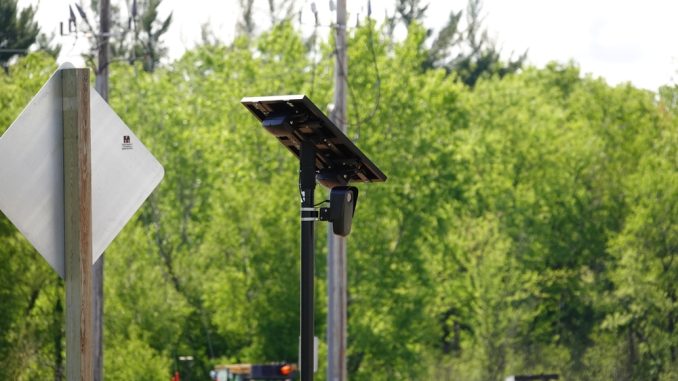
Flock Safety now operates more than 120,000 cameras across practically every state in the country, controlling more than 80 percent of the American ALPR market.
More than 200 cities have already terminated their Flock contracts in 2026.
At the peak of the backlash in August, cities were cutting ties at a rate exceeding three cancellations per day.
FBI Director Kash Patel testified at the Hawley hearing that the Bureau accesses Flock cameras on a case-by-case basis as deployed by local jurisdictions.
The bill carves out exceptions for emergency situations – locating a missing person, responding to an imminent threat, or tracking a terrorism suspect.
The federal government spent years pushing grant money into local departments to build this exact surveillance infrastructure.
Now those same cameras are jailing innocent women, enabling officers to stalk ex-partners on taxpayer time, and logging the movements of every American who has done nothing wrong.
Flock Safety's network operates with no warrant requirement and – until now – no real consequence for what happens when the technology destroys someone's life.
Steube's bill changes that calculation using the only lever Washington has ever truly understood.
Comply with the Fourth Amendment, or lose the funding.
Sources:
- Rebeka Zeljko, "EXCLUSIVE: Florida Congressman Looks To Crack Down On Warrantless Flock Surveillance," The Daily Caller, September 24, 2026.
- "U.S. Senate investigates Flock camera abuses after innocent Florida woman jailed for 13 days," Fox 13 Tampa Bay, September 23, 2026.
- "Lawmaker leads hearing on Flock camera network," The Hill, September 23, 2026.
- "Rep. Steube Introduces FLAFO Act to Rein In Warrantless 'Flock Safety' Surveillance," Rep. Greg Steube Press Release, September 25, 2026.
- "Steube introduces FLAFO Act to stop federal agencies from using warrantless 'flock' camera surveillance," Florida Voice News, September 25, 2026.
- "Police Have Reportedly Used License Plate Readers to Stalk Romantic Interests Dozens of Times in Recent Years," Institute for Justice, April 27, 2026.