
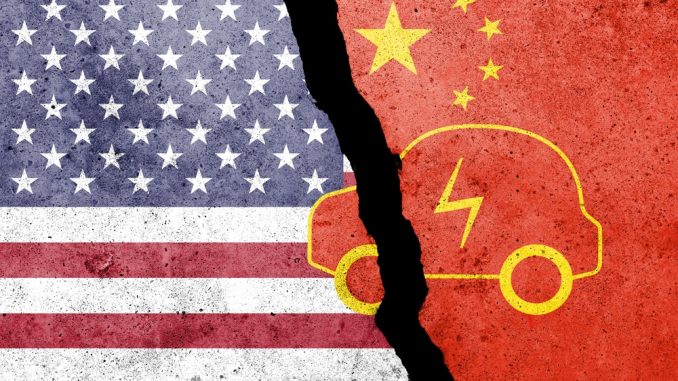
Ford CEO Jim Farley has been warning Washington for two years that Chinese EVs would destroy American automakers.
Canadian Prime Minister Mark Carney flew to Beijing and handed Xi Jinping the keys to North America.
Trump is the only thing standing between Detroit and the end of American manufacturing as we know it.
BYD Is Already at the Border and Canada Just Cut the Tariff to 6 Percent
Chinese EV maker BYD has already filed the paperwork with Transport Canada.
The first wave of Chinese EVs – up to 24,500 vehicles between March and August alone – is entering Canada right now under a deal Carney signed personally in Beijing in January.
One hundred percent tariffs, gone.
Replaced with 6.1 percent – a level that makes it profitable for Beijing to flood North America with subsidized vehicles.
Carney got nothing in return that protects a single American or Canadian auto job.
Palmer Luckey, founder of Anduril Industries, explained exactly why this matters on Joe Rogan's podcast last October.
"China would be thrilled if they could subsidize their way into destroying the American automotive apparatus, partly for economic reasons," Luckey said.
He was not being dramatic.
America won World War II because Detroit could flip car factories into weapons factories almost overnight.
Ford eventually hit one B-24 bomber every 63 minutes off the Willow Run line.
Chrysler built tanks.
GM built aircraft engines and artillery shells.
That industrial base – the auto plants, the skilled workers, the supply chains – is the exact target Beijing is aiming at.
Wipe it out, and there is no arsenal of democracy left to mobilize when it counts.
China Used This Same Playbook to Wipe Out Americas Solar Industry
China spent $230.9 billion subsidizing its EV sector between 2009 and 2023 alone.
BYD received $2.1 billion in government subsidies in 2022 – equivalent to 3.5 percent of its entire revenue for that year.
The goal is not profit.
The goal is to sell below cost, long enough, until every competitor is dead.
China ran the same playbook in solar panels – subsidizing its way from 5 percent of global exports in the mid-2000s to 67 percent by 2018.
Global prices crashed 80 percent, and roughly 500 foreign solar companies went bankrupt.
Five hundred companies that could compete with China were gone.
The Alliance for American Manufacturing warned in 2024 that cheap Chinese vehicles backed by Beijing's money "could end up being an extinction-level event for the U.S. auto sector, whose centrality in the national economy is unimpeachable."
Ten million American jobs – Michigan, Ohio, Indiana, Kentucky, Tennessee – depend on that sector surviving.
These Are Spy Cars and a Former Government Official Just Said So Under Oath
These are not just cars.
A modern Chinese EV generates more than 1,000 gigabytes of data per hour – microphones, cameras, GPS, 5G connectivity, synced smartphone data – all of it streaming to manufacturer servers in China.
China's National Intelligence Law requires every Chinese company to hand over any data the government requests.
No exceptions.
No court order required.
Margaret McCuaig-Johnston, a former senior Canadian government official, testified before Canada's Parliament on March 12 that Chinese EVs run Baidu software that collects vehicle data and transmits it directly to China.
She told lawmakers directly: "Chinese companies are required to spy on behalf of Chinese intelligence services if requested."
Poland banned Chinese vehicles from all military installations over exactly this concern, and British lawmakers followed — citing the legal right Beijing holds to access data collected by cameras and sensors in any vehicle built with Chinese technology.
Ontario Premier Doug Ford called them "spy cars."
Canadian Conservative politician Pierre Poilievre called them "roving surveillance operations."
Both are right.
BYD Wants to Build a Factory in Canada and Use It to Reach the US Market
Because Canada and the United States share nearly identical vehicle safety and emissions standards, a car certified in Canada can cross the border with almost no friction.
Ford CEO Jim Farley called that an "existential threat."
GM chief Mary Barra called it "a very slippery slope."
The slipping has already started.
BYD's executive vice president has publicly stated the company is considering building a manufacturing facility in Canada – not just selling cars there, but planting a production base one bridge away from Michigan.
Auto industry consultant Tu Le was direct: "The countdown clock is on in the United States. It just got louder."
Trump has held the wall at home – tariffs above 100 percent, Commerce Department rules barring Chinese software and hardware from vehicles sold here.
Carney just showed Beijing exactly where the fence ends.
Every Chinese EV rolling through Canada is mapping American roads, tracking movements, and sending data to Beijing – while Beijing works to make sure there is no American auto industry left to fight back with.
Trump sees what is happening.
Carney is helping it happen.
Sources:
- Sara McGiff, "Canada's ultimate revenge on Trump over tariffs gathers pace," Daily Mail, March 18, 2026.
- "Don't Let Chinese EV Makers Manufacture in the United States," ITIF, September 17, 2025.
- "Trojan Horse," Foundation for Defense of Democracies, December 11, 2025.
- Scott Paul, "U.S. must keep Chinese automakers out," Detroit News, March 16, 2026.
- "Canada welcomes Chinese vehicles as U.S. automakers pull investments," Detroit News, January 27, 2026.
- "BYD applies to export electric vehicles to Canada under the new 6.1% tariff rate," CarNewsChina, March 5, 2026.
- David Hookstead, "Palmer Luckey Reveals China's Plan To Beat America," OutKick, October 23, 2025.
- "Former Official Warns Canada MPs About Data Collection, Surveillance Risks in Chinese-Made EVs," NaturalNews, March 21, 2026.
- "Spy cars or affordable EVs? China-built vehicles spark security debate in Canada," GlobalChinaEV, March 2026.