
In 1947, a Bedouin shepherd threw a rock into a cave near the Dead Sea and rewrote what the world thought it knew about Scripture.
Now an international team is drilling into the mountain Genesis says the Ark came to rest on.
The lab results coming this winter could settle a question believers have been asking for four thousand years.
The Durupinar Formation and Why 2026 Is the First Real Test
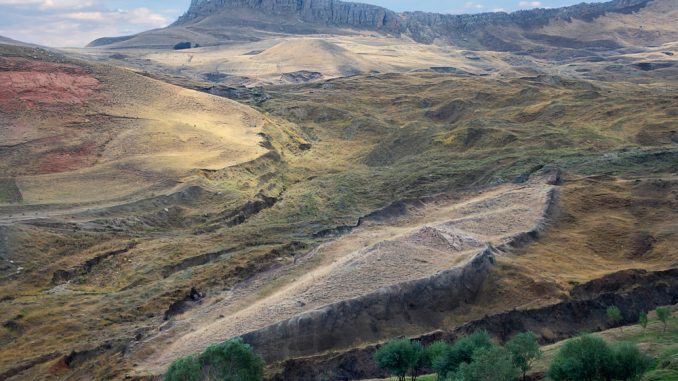
For sixty-seven years, a 515-foot boat-shaped mound in eastern Turkey has sat at the center of one of the greatest archaeological debates in history.
Turkish Army Capt. İlhan Durupınar photographed it from the air in 1959.
The structure sits 29 kilometers south of Mount Ararat – the mountain Genesis names as the resting place of Noah's Ark.
Convert Genesis 6 using the Royal Egyptian cubit – the standard Moses would have known – and Noah's Ark was exactly 157 meters long.
The mound measures exactly 157 meters.
That is not a coincidence.
Geologists spent six decades insisting the mound is a natural limestone formation.
The 1988 drilling campaign – the only previous attempt to core the site – ended when water used to cool the drill bit corrupted every sample before analysis.
The mystery went unresolved for thirty-eight years.
Noah's Ark Scans, operating in partnership with Sivas Cumhuriyet University and under official Turkish government permits, launched the largest permitted scientific core-drilling program in the site's recorded history this week.
Researchers are pulling samples from depths of up to 18 meters – nearly 60 feet – both inside and outside the formation's outline.
"For the first time in history, we are performing an extensive, permitted deep core drilling survey inside and outside the Durupınar Noah's Ark site," said Andrew Jones, Vice President of the Noah's Ark Research Project.
https://twitter.com/noahsarkscans/status/2102548998049419496
Petrified Wood Is Harder Than Limestone and the Lab Tests Are Coming
Inside the section of the formation corresponding to the hull, at roughly 4 to 5 meters below the surface, the drill penetrated several layers of organic material – then stopped cold.
The bit broke.
"At this layer, the operation stopped as we struck a layer so hard that the drill bit broke," Jones reported.
What breaks a drill bit operating at that depth?
Petrified wood is harder than limestone.
The team has not yet confirmed the material's identity – that is what the lab testing is for.
"No bedrock or solid limestone has so far been identified in the holes drilled inside the formation," Jones added.
That directly contradicts the geologists' foundational claim about the site.
Samples are now being shipped to independent third-party laboratories for compositional, organic, and stratigraphic testing, with results expected this winter.
Earlier scanning using ground-penetrating radar had already mapped what the team describes as corridors, chamber-like spaces, right-angle intersections, and a hallway running more than 250 feet beneath the surface.
Natural limestone blocks do not have 250-foot hallways.
The GOPHER Drone Mission and What Lab Results Mean for Noah's Ark
A custom-built underground exploration drone named Gopher – named for the gopher wood God commanded Noah to use in Genesis 6:14 – has been built to enter the voids the team mapped with radar.
Its camera reaches underground spaces through narrow entry points already drilled, no excavation required.
If those chambers contain structural features, the footage will exist.
Prof. Dr. Cenker Atila, the expedition's lead archaeologist from Sivas Cumhuriyet University, said every stage of investigation has produced findings that "increase our interest in the possibility that this formation may preserve evidence related to Noah's Ark."
Consider what the secular establishment has insisted for sixty-seven years: Genesis dimensions are religious poetry, not measurement, and a 515-foot boat-shaped mound in the mountains of Ararat is merely geological coincidence.
A drill team that shattered a bit on something harder than limestone 60 feet below the surface of that mound is simply having bad luck.
The 1988 team used the wrong equipment, lost every sample to water contamination, and walked away.
The 2026 team has Turkish government authorization, university oversight, radar maps of underground corridors, and a custom drone ready to go where no camera has gone before.
If those samples contain petrified wood – wood that has been mineralizing for thousands of years inside a 157-meter structure that matches Genesis to the cubit – university textbooks will face a question they have no honest answer to.
Sources:
- "Core Drilling Begins at Durupinar Noah's Ark Site, Drill Bit Shatters on Possible Layer of Petrified Wood," Globe Newswire, September 23, 2026.
- "'Darwinism Will Be Dismantled': Core Drilling at the Suspected Site of Noah's Ark Has Begun," The Blaze, September 23, 2026.
- Noah's Ark Scans, "The Ark Project," NoahsArkScans.com, accessed September 24, 2026.