
Iran put a $60,000 bounty on his head and sent hundreds of IRGC soldiers into the mountains to collect it.
The downed Air Force colonel hid in a crevice 7,000 feet up in the Zagros Mountains for more than a day while enemy search parties closed in around him.
Now a decorated TOPGUN graduate is telling Americans what that colonel actually survived – and it's something no simulator, no classroom, and no amount of training can truly replicate.
What TOPGUN Pilot Whiz Buckley Said About Ejecting From an F-15 Over Enemy Territory
Matthew "Whiz" Buckley flew 44 combat missions in F/A-18 Hornets during two Iraq tours. He's the president of the No Fallen Heroes Foundation and one of the most credible voices in America on what fighter pilots actually endure.
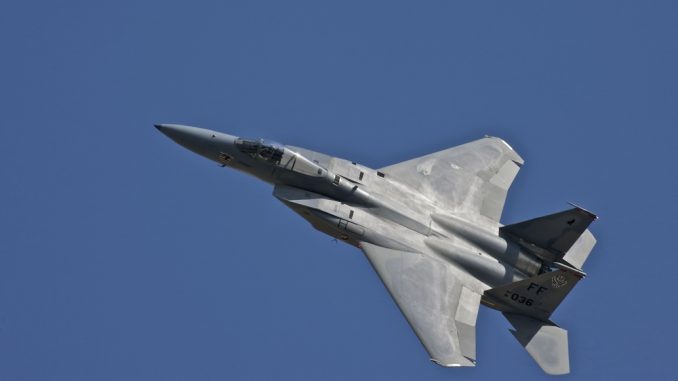
When the F-15E Strike Eagle went down over southwestern Iran on April 3, Buckley didn't sugarcoat what the crew faced the moment they reached between their legs and pulled that black and yellow handle.
"The choice is either that or die – or death," Buckley said. "So it's an incredibly violent experience."
Buckley has been in an ejection simulator. It operates at one-tenth the force of the real thing — and his back was sore for a week afterward.
The real thing drives up to 20 Gs through a human body while a wall of 500-mile-per-hour wind hits from every direction simultaneously.
Arms not locked tight can get torn from their sockets. Spinal compression injuries are routine. Early in aerial combat history, pilots lost legs and feet getting caught on the canopy during ejection.
The military's own definition of a successful ejection stops well short of "you lived." Buckley explained it plainly: the seat fires, the canopy clears, the parachute opens. What happens to the pilot after that is in God's hands.
How SERE Training Kept the Downed F-15 Colonel Alive Behind Enemy Lines in Iran
The weapons systems officer – a colonel – landed in some of the most hostile terrain on earth. Wounded. Separated from his pilot by miles. With Iranian forces scouring the valleys below and locals forming search parties after Tehran dangled a reward for his capture.
Buckley knows exactly what that colonel's training told him to do the moment his boots hit the ground.
"We're taught how to live off the land," Buckley said. "We're taught how to bend but not break."
Get away from the crash site – enemy forces go there first. Get to high ground. Stay small. Stay invisible. Don't move when you don't have to.
Every decision in those mountains is a chess move against an enemy that knows the terrain and has numbers on their side. The colonel climbed to 7,000 feet and found a crevice. He held that position for more than 24 hours while the CIA fed false intelligence into Iranian channels to pull search teams away from his actual hiding spot.
Delta Force and SEAL Team Six were both deployed. Over 155 U.S. aircraft covered the operation.
When the colonel was finally reached, two MC-130J transport planes sent to extract him malfunctioned on the ground. U.S. forces destroyed them on the spot – along with four helicopters – rather than let sensitive equipment fall into Iranian hands. They loaded the colonel onto three replacement aircraft and flew him out.
Trump announced the rescue just after midnight on Easter Sunday: "SAFE and SOUND!"
Operation Epic Fury Proved America Leaves No Pilot Behind
Buckley put the broader mission in terms any American can understand.
The U.S. flew over 13,000 combat sorties in roughly 30 days of Operation Epic Fury. One aircraft went down inside Iran – the first manned American aircraft shot down over Iranian soil since the war began in February. Both crew members came home. Zero Americans killed in the rescue.
"That's a 99.98 mission success rate," Buckley said. "But they only have to get lucky once for it to look like a win to them."
Iran thought they had that win. They paraded the wreckage on state television. They called it a triumph of their "new advanced air defense system." They sent hundreds of soldiers into the mountains.
They got nothing.
That colonel – wounded, alone, hunted at high altitude – held his position long enough for the most lethal military force in human history to come get him.
The same commando unit that killed bin Laden ran the rescue. Israel ran air cover. The CIA ran a deception operation inside enemy territory. America does not leave its people behind.
Trump called it "one of the most daring Search and Rescue Operations in U.S. History." Netanyahu called it a "perfectly executed American mission."
The Iranians thought an Easter Sunday bounty hunt in the Zagros Mountains was going to embarrass the United States.
They found out what American warriors actually look like.
Sources:
- Caitlin McCormack, "The 'violent' reality of ejecting from an F-15 faced by brave US pilots revealed," New York Post, April 6, 2026.
- "'Safe and Sound': How a U.S. Airman Shot Down in Iran Was Rescued From a Mountain Crevice," Time, April 5, 2026.
- "Second crew member from F-15 downed in Iran rescued by U.S. forces," Axios, April 5, 2026.
- "Former Navy fighter pilot talks about US mission to rescue pilot shot down over Iran," Fox News/NPR transcript, April 6, 2026.
- "US pilot rescued from downed F-15E fighter jet in Iran," Fox News, April 3, 2026.
- "Former TOPGUN pilot declares Iran military 'over with' amid US air superiority," Fox News, March 3, 2026.
- "The Anatomy of an Extraction: How SERE Doctrine and a CIA Deception Saved an American Airman," Kurdistan 24, April 6, 2026.