
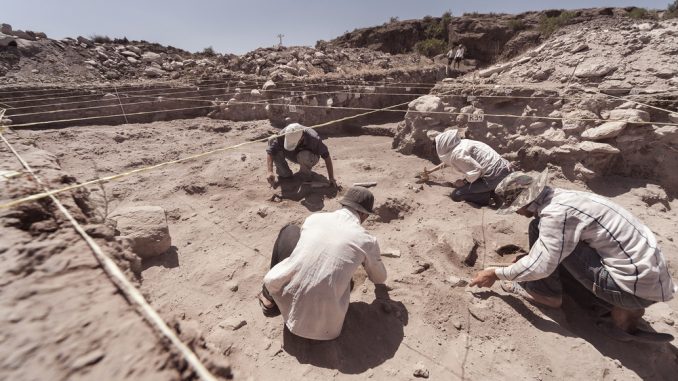
A monk named Abba Kir died in an Egyptian desert guesthouse 1,600 years ago and carved his name in stone at the door.
Archaeologists just found it.
What else they pulled out of that building last week will make you rethink everything you thought you knew about where your faith came from.
Inside the Ancient Egypt Discovery That Rewrote the History of Christian Monasticism
The Qallaya area of Egypt's Beheira Governorate isn't famous the way the pyramids are famous.
But it should be.
Egypt's Supreme Council of Antiquities confirmed last week that excavations at the site – the second-largest monastic community in the history of Christian monasticism – revealed a fully intact 5th-century building with 13 rooms, wall paintings, a marble column, and a limestone inscription that officials believe marks the grave of a monk who lived there 1,600 years ago.
Preliminary readings of the inscription suggest it reads: "Abba Kir, son of Shenouda."
Officials believe it is a tombstone, left at the entrance to one of the chambers.
A man lived in this place, prayed in this place, and died in this place before the fall of Rome.
His name is still legible.
How the Oldest Christian Monastery Tradition on Earth Was Born in This Desert
Saint Basil – who built the monastic rules still followed by the Eastern Orthodox Church today – traveled to the Egyptian desert in 357 AD.
He came to take notes.
Saint Benedict, whose rule still governs every Benedictine monastery on earth, modeled his entire structure on what the Egyptians built first.
Saint Jerome, who translated the Bible into Latin – the version that shaped Western Christianity for a thousand years – came here to sit at the feet of these monks.
Every monk who ever took a vow of silence, every nun who ever entered an abbey, every Christian who ever went on a weekend retreat traces that tradition back to a handful of men living in Egyptian sand with nothing but prayer and conviction.
The Qallaya guesthouse is where that tradition was built, one room at a time.
The 1600 Year Old Coptic Monastery That Held a Dead Monk's Name at Its Door
What makes the Qallaya discovery remarkable isn't just its age.
It's what the building tells you about the people inside it.
The 13-room structure wasn't a hermit's cave.
It was organized, functional, and built for community – with individual living quarters, communal spaces, a kitchen, storage rooms, and a large hall built to receive visitors.
Excavation leader Dr. Samir Rizk Abdel-Hafez described frescoes of monastic figures, a mural of two gazelles surrounded by flowers, and a braided pattern painted in red, white, and black.
A room at the center of the building – with a limestone cross – was used for prayer.
Dr. Hisham El-Leithy, Secretary-General of Egypt's Supreme Council of Antiquities, said the wall paintings rank among the most important sources for studying early Coptic art in Egypt.
These monks weren't hiding from the world.
They were building one.
The Egypt Inscription That Survived the Fall of Rome
The limestone slab is the detail that stays with you.
Abba Kir, son of Shenouda, carved his name into stone at the threshold of a chamber in a desert guesthouse 1,600 years ago.
The Arab conquest swallowed Egypt within two centuries of his death.
The Roman Empire collapsed.
The world he knew vanished completely.
His name survived all of it.
The faith you inherited didn't come from a government program or an Ivy League theology department.
It came from men like Abba Kir – who lived in a 13-room desert guesthouse, carved his name in stone, and trusted that someone would still be reading it 1,600 years later.
He was right.
Sources:
- Andrea Margolis, "Archaeologists unearth 1,600-year-old Christian monastic site with paintings, mysterious inscription," Fox News, March 28, 2026.
- Heritage Daily, "Archaeologists unearth 5th-century Coptic monastic building in Egypt's Beheira Governorate," March 24, 2026.
- Heritage Daily, "Monastery discovered in Egypt's Wadi El-Natrun sheds light on early monastic life," March 24, 2026.
- Archaeology Magazine, "Fifth-Century Monastic Site Explored in Egypt," March 25, 2026.
- Greek Reporter, "1,600-Year-Old Monastic Structure Unearthed at Key Coptic Site in Egypt," March 24, 2026.