
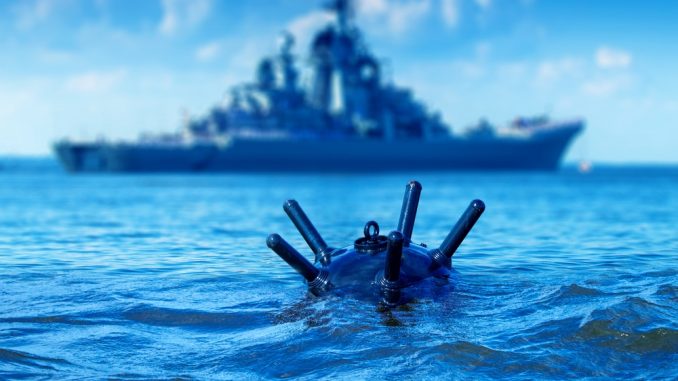
The last time Iran mined the Strait of Hormuz, it nearly sank a U.S. warship.
That was 1988 – and America scrambled for months to find enough minesweepers.
This time, the Navy showed up with something Iran has never faced before.
Iranian Mines in the Strait of Hormuz Have Met Their Match
The naval mine is the oldest trick in Iran's playbook. A weapon first designed for the Russian Empire in 1908. Steel shell, contact detonation, a few hundred pounds of explosives. Cost: roughly $1,500.
Iran deployed them throughout the Persian Gulf during the Tanker War of the 1980s.
On April 14, 1988, one of those mines detonated beneath the USS Samuel B. Roberts in the middle of the Persian Gulf shipping channel.
The blast punched a 15-foot hole in the hull, flooded the engine room, and snapped the keel. Ten sailors were injured. The ship survived only because the crew held it together through five hours of firefighting and damage control. Repairs cost $89.5 million.
Iran has been running the same play ever since: cheap weapons, maximum disruption, plausible deniability.
This time, Trump isn't scrambling to find minesweepers.
How Navy Underwater Drones Are Clearing the Minefield
The Navy is running two simultaneous drone operations in the Strait right now, according to Fox News.
Underwater, torpedo-shaped UUVs sweep the ocean floor using high-resolution sonar, mapping every object on the seabed and flagging potential mines for elimination. Above the waterline, surface drones tow sonar systems through narrow shipping lanes while helicopters scan for mines closer to the surface.
When a mine is identified, remotely controlled systems move in – either detonating it in place or punching a hole in the casing so it sinks harmlessly. Several successful detonations have already been confirmed.
Retired Vice Adm. Kevin Donegan, who previously commanded the Navy's 5th Fleet, told Fox News the transition away from wooden-hulled minesweepers never worried him.
"To be honest, that the minesweepers retired was never a concern to me, because we had brought in newer technology."
That newer technology is now proving itself in combat conditions for the first time.
Defense analyst Bryan Clark of the Hudson Institute confirmed the timeline.
"The mine neutralization part is really the long leg of the process." Finding mines can happen within a couple of weeks, he said. Full clearance of a waterway takes longer.
Trump isn't waiting. He ordered the operation "tripled up" this week.
What Biden Left Behind and What Trump Inherited
Here's what the left-wing media won't tell you: the Navy's entire minesweeping capacity was in transition when Iran started laying mines.
The old Avenger-class ships – wooden-hulled, purpose-built, effective – were loaded onto a cargo vessel in January and sent to Philadelphia for scrap.
Their replacements, Independence-class Littoral Combat Ships carrying unmanned mine-countermeasures packages, had just arrived in theater.
Two of those LCS ships were undergoing maintenance in Singapore when the shooting started.
The Pentagon's own testing office noted in a March report that the Navy conducted zero operational testing of the LCS mine-countermeasures package in fiscal year 2025. Zero.
None of this was Trump's doing. The transition timeline, the readiness gaps, the decision to scrap four dedicated minesweepers before their replacements were combat-proven – that happened on Biden's watch.
Trump inherited a problem and is closing it in real time.
What This Actually Costs Iran
The Strait of Hormuz carries 20 percent of the world's daily oil supply. Iran's closure of it since late February represents – according to the International Energy Agency – the largest supply disruption in the history of the global oil market. Brent crude surged to $126 per barrel at its peak.
The Dallas Fed estimates the closure could trim annualized global GDP growth by nearly three percentage points.
Iran thought that pressure would break Trump.
It didn't.
Now Tehran is watching American robots systematically detonate their mines one by one. Every confirmed detonation is a signal to the world's shipping industry – and to Iranian planners – that the clock is running out on the only weapon keeping the strait closed.
Iran spent 38 years perfecting a $1,500 weapon. Trump sent robots to blow them up one by one. That's not a stalemate. That's a rout.
Sources:
- Jack Davis, "Navy Sends Robots to Take Out Iranian Mines in Strait of Hormuz," The Western Journal, April 26, 2026.
- "A Brief History of U.S. Naval Mine Warfare in the Persian Gulf, 1979–Present," Center for Maritime Strategy, April 2026.
- "The Mine Gap: America Forgot How to Sweep the Sea," Foreign Policy Research Institute, March 25, 2026.
- "Crisis in Mine Countermeasures," U.S. Naval Institute Proceedings, April 2026.
- "Pressure Mounting to Overcome Mine Fears for Ship Transit in Strait of Hormuz," Stars and Stripes, April 23, 2026.
- Dallas Federal Reserve Bank, "What the Closure of the Strait of Hormuz Means for the Global Economy," March 20, 2026.