
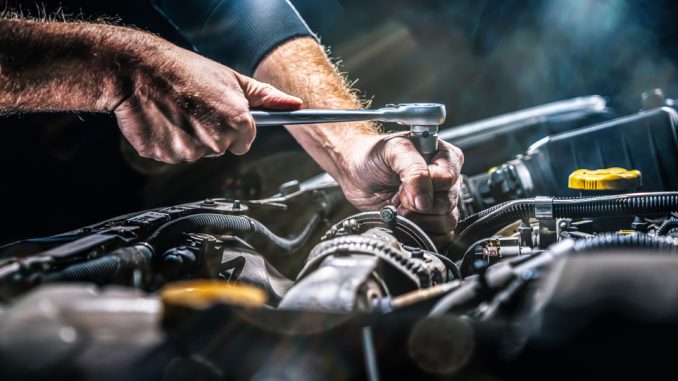
The check engine light comes on and the dealer charges $180 just to tell the owner what it means.
Trump signed the order that cracked the door open to letting Americans make their own repairs.
Congress had one bill that could have made it permanent – and what happened to it inside the committee tells the whole story.
How Automakers Built a Car Repair Monopoly and Made Dealers the Only Option
Americans buy a $50,000 car, make the $800-a-month payment, and the moment something goes wrong, the car tells them to call the dealer.
That is not an accident.
Modern vehicles run on software, and automakers own that software – along with every diagnostic code, sensor reading, and repair data point it generates.
The neighborhood mechanic can see the check engine light.
The dealer's computer tells him exactly what triggered it.
That gap is worth billions. Vehicle maintenance and repair costs jumped 36 percent between May 2022 and May 2026, according to Bureau of Labor Statistics data.
Americans are being steered into dealerships not because dealers do better work but because automakers locked everyone else out of the tools to do it at all.
The independent repair sector is a $392 billion industry that handles the bulk of out-of-warranty automotive work in America. That competition is what keeps dealer prices from going completely vertical.
When automakers cut independent shops off from diagnostic data, that competition dies – and drivers pay for it at the counter.
Trump's Freedom to Fix Order Cut Car Repair Costs – Then Hit a Wall
On June 29, Trump signed a presidential memorandum titled "Lowering the Cost of Living by Promoting the Freedom to Fix," directing the EPA to expand access to aftermarket parts and clear the California Air Resources Board bottleneck that had been gatekeeping parts certification for over a year per application.
The EPA acted within two days. Administrator Lee Zeldin issued guidance reaffirming that under the Clean Air Act, manufacturers must give independent shops the same service and repair information they provide their own branded dealerships – covering diesel exhaust systems, emissions controls, and onboard diagnostics for highway vehicles.
Farmers had already seen the same fight won. February 2026 EPA guidance confirmed that agricultural and non-road equipment operators could legally fix their own machines.
The White House estimated the move saved farmers an average of $33,000 per repair that previously had to be routed through a manufacturer-approved bottleneck.
Trump deserves credit for both. He used every authority he had.
The problem is that a presidential memo is only as permanent as the next administration that inherits it. It can be rewritten in a morning. Only Congress can make it stick.
The REPAIR Act Would End the Auto Repair Monopoly – Congress Gutted It Instead
The REPAIR Act – the Right to Equitable and Professional Auto Industry Repair Act – is the legislation that would do what the presidential memo cannot.
It would require automakers to give drivers and independent shops the same diagnostic tools, repair data, and vehicle-generated information already available to dealer networks. It would also give the Federal Trade Commission enforcement power to go after manufacturers who refused.
The bill passed out of the House Energy and Commerce subcommittee in February 2026 on its way to becoming law.
Then the committee – responding to automaker lobbying pressure – stripped it.
In May 2026, the Energy and Commerce Committee folded a narrowed version of the REPAIR Act into the Motor Vehicle Modernization Act (H.R. 7389) and passed it 48-1. The problem is what got cut – the provisions covering telematics and direct wireless data access, the exact data streams automakers are already using to route customers back to dealers.
Without wireless data access, the bill locks in where things stood in 2014 and leaves the most important part of the fight untouched.
Rep. Neal Dunn of Florida, the bill's lead sponsor, wants House leadership to restore the full REPAIR Act language when H.R. 7389 hits the floor. Rep. Warren Davidson of Ohio, who co-sponsored the REPAIR Act and praised Trump's June memo, is pushing the same thing.
Right to Repair Has a September 30 Deadline and Congress Is Running Out of Time
The Motor Vehicle Modernization Act is expected to ride alongside the BUILD America 250 Act – the $580 billion surface transportation reauthorization that expires September 30, 2026.
Five weeks.
If the gutted version clears the floor unchanged, drivers are back to square one on the data that matters most. Automakers keep the wireless diagnostic stream. Independent shops keep getting cut out. And the prices that already climbed 36 percent in four years have nothing to hold them down.
Trump's words when he signed the June memo: too many Americans are being told that nobody is allowed to fix their car.
Congress has five weeks to prove him wrong.
Sources:
- Commercial Vehicle Solutions Network, "Right to Repair Fact Sheet," CVSN, July 1, 2026.
- U.S. EPA, "EPA Delivers on President's 'Freedom to Fix' Memorandum for Vehicles and Equipment," EPA.gov, July 1, 2026.
- SEMA, "U.S. House Committee Advances Legislation to Enact Right-to-Repair Provisions," SEMA.org, June 22, 2026.
- Warren Davidson, "Drivers Deserve the Same Tools and Data Automakers Give Dealers," The Washington Times, August 22, 2026.
- Carscoops, "Fixing A Ford Once Took A Craftsman Set, Now It Takes A $2,500 Subscription," Carscoops.com, July 19, 2026.
- Daily Signal, "Congress Might End Automakers' Monopoly on Car Repair Data," The Daily Signal, May 19, 2026.