
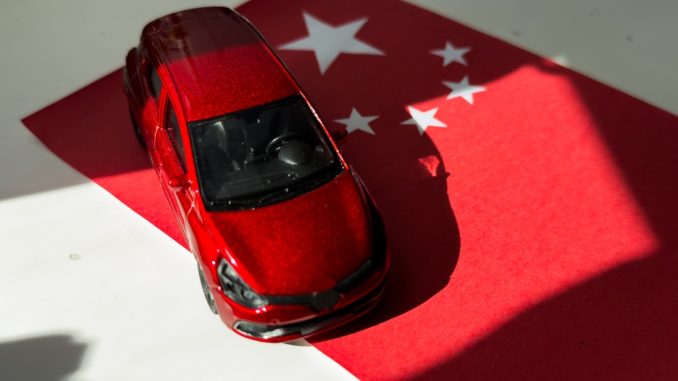
Detroit just sent Trump a letter begging him to keep Chinese automakers out of America.
One of the men behind that letter spent all of 2024 driving a Chinese car as his daily driver.
And what Ford CEO Jim Farley admitted about that car tells you exactly how bad things already are.
Ford CEO Farley Admitted He Drives a Chinese Car Every Day
Ford CEO Jim Farley's daily driver in 2024 was a Xiaomi SU7 – a Chinese electric sedan his own company cannot come close to matching on price or technology.
When asked about it, Farley admitted he didn't want to give it up.
The CEO of Ford Motor Company spent a year telling anyone who would listen that a Chinese car is better than anything Detroit is building.
"We are in a global competition with China, and it's not just EVs," Farley said. "And if we lose this, we do not have a future at Ford."
He knows exactly what's coming.
BYD Sells a $14,000 EV While Chevy Charges $33,600 for Its Cheapest
BYD just unveiled a fully electric crossover SUV priced at $14,000.
The cheapest American EV on the market right now is the Chevrolet Equinox EV at $33,600.
That is not a price gap. That is a chasm.
The Alliance for Automotive Innovation – the lobbying group representing Ford, GM, and Toyota – sent Trump a letter last month calling the Chinese threat "an extinction-level event."
China exported 7 million vehicles in 2025.
Detroit exported 1.3 million.
And while American lobbyists are writing panicked letters, Geely's global communications chief is publicly stating that US market entry is a question of "when and where" – not "whether."
Geely already has a factory in South Carolina sitting largely idle – the Volvo plant in Ridgeville – and automotive analysts say Geely's Zeekr EVs could be rolling off that line by 2028.
The invasion isn't coming. It's already positioned on America's doorstep.
Palmer Luckey Says China Plans to Destroy Detroit to Win the Next War
Defense tech founder Palmer Luckey – the man building America's next-generation weapons systems at Anduril Industries – went on Joe Rogan’s podcast and delivered a warning about protecting America’s auto industry.
"We won World War II because we had all this automotive and other industrial capacity," Luckey said. "China would love to wipe out the American automotive industry, partly for economic reasons, because it also means we will never be able to fight a war against them."
He wasn't finished.
"If China can wipe out our industrial capacity entirely, they never need to worry about fighting a war with the US again – because they know we wouldn't be able to get back in the game fast enough to matter."
One move. Economic war and kinetic war, won simultaneously.
Beijing's government subsidized automakers aren't just trying to take market share from Ford and GM.
They're trying to dismantle the industrial backbone that turns a nation of 330 million people into a war machine when it matters.
America did it in 1941. Auto plants converted to tanks, bombers, and jeeps in months.
That doesn't happen if those plants are owned by Beijing.
Chinese Cars Are Already Surrounding America Through Canada and Mexico
While Washington debates, Ottawa already folded.
Canadian Prime Minister Mark Carney inked a deal with Beijing in January allowing 49,000 Chinese EVs into Canada annually at a slashed tariff.
BYD is actively considering building a Canadian factory.
Stellantis is in talks to produce Chinese Leapmotor EVs at an idled plant near Toronto.
And a sweeping federal rule that took effect in March 2026 tells you exactly what Washington thinks about Chinese technology in vehicles – it now prohibits American automakers from using any software developed by Chinese entities in connected vehicle systems.
The reason is not subtle.
Chinese cars are rolling surveillance platforms. Cameras. Microphones. GPS logging every route driven. US officials have publicly warned that foreign adversaries with sufficient access could use that infrastructure to interfere with vehicles moving through American neighborhoods.
Trump's 100% tariff wall on Chinese EVs is the only thing standing between American showrooms and the situation Mexico and Canada are already living.
Trump and Xi Summit Could Blow Open the US Auto Market to Chinese Cars
When Japanese automakers took 21% of the American market in 1980 with cheaper, better-built cars, Reagan didn't panic.
He negotiated voluntary export restraints, bought Detroit four years of breathing room, and Japan responded by building American factories – Honda in Ohio, Toyota in California.
Those plants still employ Americans today.
China is not Japan.
Japan was a Cold War ally with no interest in dismantling American industrial power.
China is a country Palmer Luckey believes could move on Taiwan as early as 2027 – counting on American manufacturing weakness as a deliberate military advantage.
Trump's demand for American factories and American workers as the price of entry is right.
But the planned Trump-Xi summit is coming fast.
The question isn't whether Trump understands the threat – Farley made sure of that, one Xiaomi SU7 at a time.
The question is whether the same president who built the wall holds the line when Xi sits across the table and starts talking about a deal.
Sources:
- Keith Naughton, "Cheap Chinese Cars Are Waiting on Detroit's Doorstep," Bloomberg, April 2, 2026.
- "US Auto Groups Press Trump to Hold the Line on China EVs," Automotive World, March 2026.
- "Carmakers Warn US Over Chinese Autos Ahead of Trump-Xi Summit," Bloomberg, March 13, 2026.
- "US Automakers Outing Chinese Code from Connected Cars Per Federal Anti-Chinese Code Rule," Auto Connected Car News, March 30, 2026.
- "Chinese Automakers Eye US Market: A Game-Changing Shift," Automotive Manufacturing Solutions, February 17, 2026.
- "The Import Quota That Remade the Auto Industry," American Compass, November 2023.
- Palmer Luckey, The Joe Rogan Experience, October 17, 2025.