
Geologists spent decades laughing at Christians who believed Noah's Ark was buried in Turkey.
Now researchers have drilled 30 feet inside it and pulled out charred wood.
Four labs in four countries are about to tell us something that could change everything.
The Mount Ararat Formation Skeptics Have Mocked Since 1959
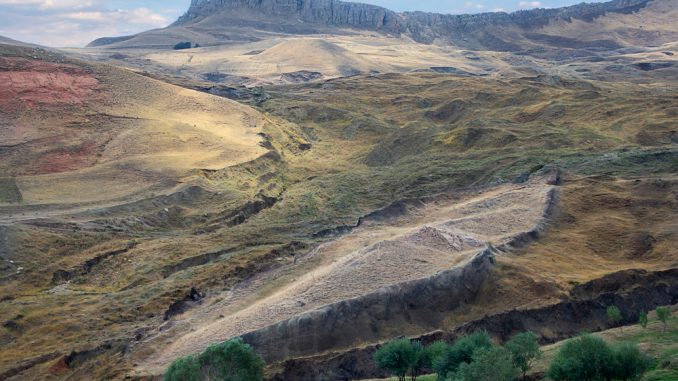
The Durupinar site sits near Mount Ararat in eastern Turkey – exactly where the Bible says Noah's Ark came to rest.
It measures roughly 515 feet long – consistent with the dimensions described in Genesis.
Turkish Army Captain İlhan Durupınar first spotted the boat-shaped ridge in aerial photographs in 1959, and the debate never stopped.
Geologists published a formal paper in 1996 calling it "a natural rock structure" – case closed, believers are cranks, move along.
The Turkish government never bought it.
Turkey officially declared the site to be Noah's Ark in 1987 and built a national park and visitors' center there that still stands today.
For decades the debate remained a stalemate – believers pointing at the shape, skeptics waving their geology paper.
This year, someone finally started drilling.
Thirty feet down, they found something that has no business being inside a natural rock formation.
Charred Wood 30 Feet Underground at a Site Matching Biblical Dimensions
The Noah's Ark Research Project, backed by Turkish universities, spent 2026 conducting the most systematic investigation of this site in sixty years.
A 20-person team collected roughly 1,000 soil samples from 150 different locations, working for the first time under official Turkish government oversight with verified chain-of-custody protocols.
Radar surveys led by scientist Khosrow Bakhtar detected what researchers describe as man-made structures below the surface – rooms and passages too organized to be geological.
Then the drilling team pulled something nobody was expecting from nearly 30 feet underground: charred wood fragments with visible grain patterns and growth rings.
https://twitter.com/BrightInsight6/status/2120242925913375046
Archaeologist Cenker Atila, who oversees the excavation for Sivas Cumhuriyet University, called the fragments "very ancient" in his professional judgment.
"Too many coincidences have come together to be ignored," Atila told Fox News Digital.
The formation sits in the precise location described in holy texts, its dimensions match the biblical specifications, and Atila says it shows the same three-level internal structure Genesis describes for the Ark.
The carbon signature inside the formation runs measurably higher than in the surrounding soil.
Ancient pottery fragments recovered near the site date to the Chalcolithic period – roughly 5,000 to 7,000 years ago – the same window biblical scholars place the flood.
The wood samples are now at four independent laboratories in four different countries, with the team planning to apply for excavation permits once results are in hand.
The soil analysis is still ongoing – the team is also examining whether samples from inside the formation contain any trace of human or animal remains.
Carbon Dating at Four International Labs Is About to Answer the Biblical Archaeology Question
Decades of dismissal from the credentialed class never stopped researchers from coming back to this site.
Andrew Jones, lead researcher for the project, described what that dismissal looks like up close.
"I have friends who are atheists or agnostic, and they think that I'm looking for Santa's house or something," Jones told Fox News Digital.
He kept drilling.
David Fasold – one of the geologists who co-authored the 1996 paper calling this "just rocks" – had spent years before that completely convinced the site was real.
He signed that paper anyway.
The science was never as settled as the experts pretended.
This time, the investigation came with something it never had before – official Turkish government authorization, documented chain of custody, and four international labs cross-checking the same physical samples.
That is exactly the standard skeptics demanded for years – and now it exists.
The funding behind all of it comes not from institutions but from everyday people who gave money because they want the question answered.
Lauren Witzke, marketing and fundraising director for Noah's Ark Scans, called the discovery "world-shaking."
If that carbon dating comes back ancient, if the wood confirms a vessel buried where Scripture said it would be, the scientists who spent sixty years calling believers fools will have some explaining to do.
Faith never needed their permission.
But watching science catch up will be deeply satisfying.
Sources:
- Andrea Margolis, "Noah's Ark site yields first look at charred wood fragments recovered deep below soil," Fox News Digital, November 9, 2026.
- "Noah's Ark Mystery Enters New Phase as Researchers Probe Deep Beneath Site," Fox News Digital, 2026.
- "Optimism, Caution Accompany News Over Location of Noah's Ark," Baptist Press, 2026.