
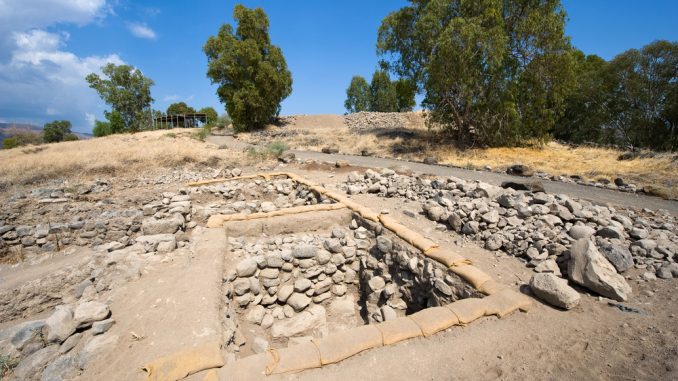
Skeptics have spent decades insisting the Bible is mythology.
Now the ground itself is proving them wrong.
After ten years of digging along the Sea of Galilee, researchers have found something that should stop every atheist professor cold.
A Decade of Biblical Archaeology Rewrites the Map
The El-Araj Excavation Project has been working the northeastern shore of the Sea of Galilee since 2016.
What they were looking for was Bethsaida – a city the Gospels describe as the hometown of the apostles Peter, Andrew, and Philip, the site of Jesus healing a blind man, and the region where He fed 5,000 people with five loaves and two fish.
For centuries, scholars debated whether Bethsaida was real or legend.
Steven Notley, biblical scholar and academic director of the project, now has his answer.
"Since 2016, we have not uncovered a single thing that would challenge or question the identification of the site as Bethsaida," Notley told Fox News Digital.
"Instead, everything we find each season, the evidence gets stronger and stronger and stronger."
Notley says he is now "100%" certain.
What Archaeologists Found at the Sea of Galilee
The physical evidence at El-Araj reads like a checklist pulled straight from the Gospels.
Thousands of lead fishing weights turned up across the site – exactly what you'd expect from a community whose economy depended on the Sea of Galilee.
Jewish stone vessels, a Roman bathhouse, and more than 200 coins still under analysis turned up alongside evidence that the village was eventually elevated into a Roman-era city called Julias under Herod Philip.
The 2026 dig season added Herodian oil lamps to the inventory – a specific type manufactured only in Jerusalem before AD 70, meaning someone carried them here during the lifetime of Jesus.
Then the frescoed walls and fine glassware changed the portrait entirely.
"One should not jump to the conclusion that these were impoverished fishermen," Notley said.
Peter and Andrew weren't poor men working a backwater lake.
They walked away from real prosperity to follow Jesus.
Then came the discovery that sent shock waves through the Christian world.
The Ancient Inscription That Identified Apostle Peter's Home
Beneath the ruins of a Byzantine basilica at El-Araj, excavators found a mosaic floor.
Inside that mosaic: a round medallion with a two-line Greek inscription.
The text names a donor and then makes a petition – to Saint Peter, "chief and commander of the heavenly apostles."
Notley called it the earliest archaeological evidence of a faith tradition recognizing Peter as chief of the apostles.
"This discovery is our strongest indicator that the basilica had a special association with St. Peter, and it was likely dedicated to him," he said.
An 8th-century bishop named Willibald had recorded something during a pilgrimage to the Holy Land: he stayed at a place he was told "is Bethsaida from which came Peter and Andrew. There is now a church where previously was their house."
A thousand years later, a mosaic in the ground confirmed what Willibald wrote down.
"You're not going to find a plaque that says 'Peter slept here,'" Notley acknowledged. "But in archaeological terms, it's about as good as you can get."
Why Biblical Archaeology Keeps Proving the Bible Right
The secular academy has spent generations telling Christians to doubt their own scripture.
Cities that Scripture named were dismissed as legend, miracle accounts were recast as metaphor, and figures central to the Gospel narrative were written off as literary invention.
Every year, a shovel proves another one of them wrong.
Nazareth – the city skeptics claimed didn't exist during Jesus' lifetime – confirmed by a first-century home discovered in 2009.
Pontius Pilate – once dismissed as a literary device – confirmed by a limestone block bearing his name and title, found in 1961.
The Pool of Siloam, where the Gospel of John records Jesus restoring a blind man's sight, was considered fictional until 2004, when a sewage repair crew accidentally struck its ancient stone steps.
The Pilgrimage Road leading from that pool to the Temple Mount was fully opened to the public earlier this year.
Bethsaida now joins that list.
The pattern here isn't coincidence.
After a decade at El-Araj, Notley framed what that means: "At least one quarter of Jesus' disciples come from Bethsaida. So it's an important site in his life, in his ministry."
The Gospels described these places with administrative precision – specific rulers, specific cities, specific bodies of water. Archaeology keeps confirming the details, one dig season at a time.
A wildfire that swept through the El-Araj site last year cleared the underbrush and revealed something unexpected: the settlement covers at least 15 acres. That's not a small outpost. That's a city large enough to match the biblical account.
"I'm looking forward to what lies ahead," Notley said.
Sources:
- Andrea Margolis, "Lost city where Jesus performed miracles has finally been identified, expert says," Fox News, September 11, 2026.
- "More First-Century Artifacts Discovered At El-Araj (Bethsaida?)," Associates for Biblical Research, August 2026.
- "Bethsaida-Julius Excavation Project 2026 Excavation Season Part 1," Lanier Center for Archaeology, September 2026.