
The world has been searching for Noah's Ark for over a century.
Now a team of American and Turkish researchers is sitting on soil data that secular scientists cannot explain away.
What they found inside that Turkish mountain – and what's coming next – is the question millions of Christians have been asking their whole lives.
Noah's Ark Soil Tests Return Results Science Cannot Explain
The Durupinar formation in eastern Turkey entered the modern record in 1959, when Turkish Army Captain İlhan Durupınar identified its unmistakable boat shape in an aerial photo taken during a NATO mapping mission.
Decades of skeptics called it a rock.
Then Andrew Jones and the Noah's Ark Scans team collected 88 soil samples from 22 locations inside and outside the formation in 2024.
The results stopped the argument cold.
Soil inside the boat shape carried three times more organic matter than the surrounding mountainside.
Potassium levels – a direct marker of wood ash decomposition – ran 38% higher inside the boundary than outside.
The pH difference between interior and exterior measured eight times over.
Australian soil scientist Bill Crabtree, who designed the sampling survey, said that potassium levels, organic matter, and pH all shift when organic material decays underground.
A rock does not do that.
Ground-Penetrating Radar Finds Three Decks at Biblical Dimensions
Jones' team identified a central corridor running approximately 13 feet wide down the length of the formation – roughly four meters underground.
The scans also reveal angular, right-angle features no natural geological process produces, along with three layered structures that mirror the biblical account of the Ark's three decks.
The formation measures 515 feet in length.
The Book of Genesis describes Noah's Ark at 300 cubits.
Convert cubits – and the numbers match exactly.
Jones went on Fox & Friends First and said what millions of believers already know in their bones.
"I do believe that this is the real, decayed, buried remains of Noah's Ark, the famous ship," he said. "And we're doing our best to convince the skeptics and show the world this site."
On the tunnels buried four meters down: "Our new research has shown that there are tunnels about four meters down and about two meters high, going down the center of the boat and on the inside edge of the hull shape. We really believe that this layout, showing tunnels and also possible support beams and walls, would suggest that it's a manmade object and not just a natural formation."
On the soil: "We have the ship shape, and we're in the right location, and now we're also seeing that the soil inside is different from right outside the formation. So we have three times more organic matter found inside versus right outside. So it's a distinct object and not just part of the mountainside."
Jones told Fox News Digital the team has moved past basic questions about the site's shape: "We've moved from asking 'Does it look like a boat?' to 'Why is there a three-layered, right-angled inside structure, carbon-rich boat formation the exact length of Noah's Ark given in the Bible buried in the middle of a mountainside in the mountains of Ararat?'"
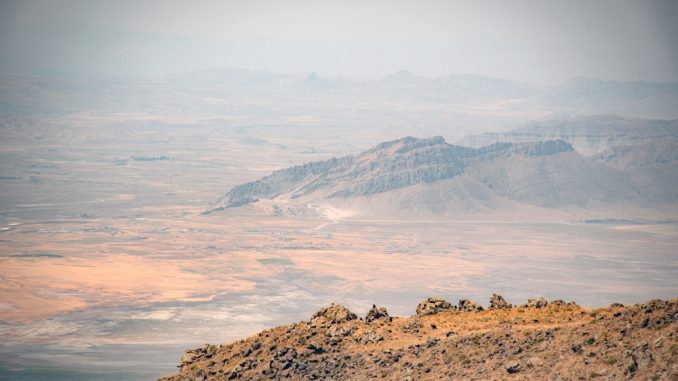
The site sits roughly 6,500 feet above sea level – the exact region Genesis identifies as the Ark's resting place.
The Scientific Community Has No Answer
Skeptics point to a 1996 paper in the Journal of Geoscience Education arguing the formation was a natural rock structure.
That paper predates the 2024 soil analysis.
It predates the 2019 ground-penetrating radar scans revealing internal corridors.
And it predates the cataloguing of 26 massive drogue stones – ancient nautical anchors with holes bored through the top – found scattered across the surrounding landscape.
Mainstream geology has not updated its position to account for any of this new evidence.
Jones' team is not claiming to have found an intact wooden ship.
Wood that old does not survive intact – not at 6,500 feet, not after 4,000 years of freeze-thaw cycles and seismic activity.
The chemical signature of a massive decayed wooden structure is sitting exactly where the Bible said Noah's Ark came to rest.
The Drilling at Durupinar That Could Prove the Bible Right
The Noah's Ark Scans team is planning the next phase: core drilling at multiple points within the formation, advanced 3D mapping, and a robotic survey of the interior tunnels – all conducted in partnership with Ağrı İbrahim Çeçen University and Turkish government oversight.
The excavation will be the first formally sanctioned dig at this precise location.
If core drilling brings up physical material consistent with processed wood or bitumen – the waterproofing compound Genesis says Noah used to seal the Ark – the conversation changes permanently.
Seventy-five years of experts called it a rock.
The soil says it isn't. The radar says it isn't. The Bible said exactly where to look – and this is where they looked.
The drilling starts soon.
Some questions answer themselves.
Sources:
- Andrea Margolis, "Could Noah's Ark Remains Be Buried in Turkey? New Findings Revive Age-Old Debate," Fox News, June 6, 2026.
- "Researcher Claims Noah's Ark Tunnels Found in Turkey Scans, Sending Robot Next," Fox News, April 22, 2026.
- "Turkey's Mount Ararat Formation Sparks Fresh Claims of Noah's Ark Discovery," Colombia One, April 22, 2026.
- "New Scan Data of Turkish Formation Is Reviving the Noah's Ark Debate," The Brighter Side of News, April 24, 2026.
- "Durupinar Radar Scans Reveal Hidden Structures Linked to Noah's Ark," The Jerusalem Post, May 15, 2025.